Game dev log – week 2

Welcome to the 2nd week of this game jam where 3 game students are spending their summer trying to make a game.
If you are reading this then I will be honest, the development is ahead in time of this log, but I write these posts after a certain time delay. This might be somewhat confusing, but it’s basically to have a bit of a wiggling room about what and when I’m writing down here.
Our progress so far: we are brainstorming, making sketches, nailing down the story outline and the characters. All these things we wanted to do before we officially started the jam, but that didn’t happen. This led to the coder not having a clear outline of what to do, since we were making story on the spot.
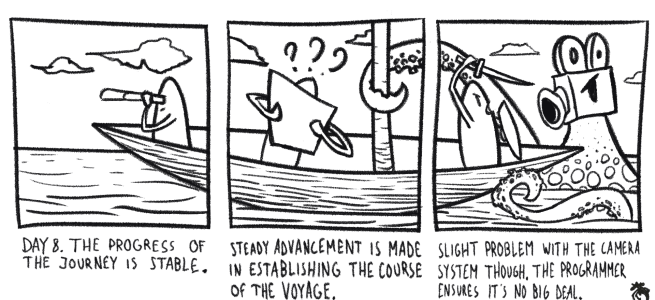
The coder began making absolutely basic functions of a platformer, that would be in the game regardless of our direction. He then discovered that making of a camera system, that is fluid and has certain behaviours, wasn’t such a simple thing to make as he assumed. That bought me and the artist some time for nailing down the concepts.
The artist is also busy establishing the art style for the story.

We jam on =)
Game dev log – week 1

… so far this sounds like the beginning of a movie
Two friends decide to take a serious step and leave their jobs, so they can find their place in life. Last money gets spent on a small studio in a small town. The heroes begin to get overwhelmed by new troubles but they are joined by a third desperate fellow who is a hacker…
(from a phone conversation)

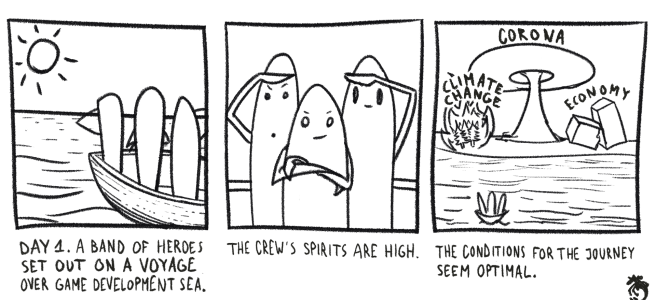
Welcome to my dev blog series where 3 wannabe game developers decide that COVID summer 2020 is the perfect time to quit jobs and test their skills in the field of making games!

The purpose of the series is to document our little adventure, perhaps learn new things, share our experience, make an infinite amount of money (a mandatory requirement in today’s game industry).

We are 3 game dev ex-students (an artist, a coder and a designer) who set out on a private game jam with a concept and a hope of creating something that might turn out fun and great.

Week 1:

Originally, we planned to have 2 weeks of pre-production for concept and design/planning. But our circumstances changed. We jumped directly into working on the prototype, writing the story and figuring out the art style at the same time.

Despite having discussed concept before, it still took a lot of talking to nail down what we’re making. And so we are off to a bit of a rough start, but we believe we can manage.

Bon voyage to us 😉

Week 2 –>

Could some high school kids make better games than AAA studios?

Apparently, they might, but obviously, they don’t have the same amount of resources as the big companies.

Imagine, there are actually kids out there who choose game development as their high school specialisation. As their final project, they get to produce a game over the course of a year. At the end of the given time, a teacher is presented with a lineup of small games. Some of these games are breathtaking. These are usually made by kids who are still interested in game development after years of high school. Some other games are clearly lacking. The low quality can be caused by any of a multitude of problems because don’t forget that this is still a school with all the stress that follows. But even with a struggle, most students deliver something just to pass the course. The kids know that and the teachers know that. And that is fine.

So, the funny observation here that I see a parallel in the quality of games by big companies in recent years and the hand-ins of less motivated high school kids. A sort of ” Nobody wanted to make this, but we made it anyway-”


It was an interesting experience to work as a game development teacher. My concept of patience has been definitely tested a lot. But the thing is that the process of making the games remains pretty similar to how it was taught at the university. That is what made me think, that perhaps I can make my little stab at AAA.


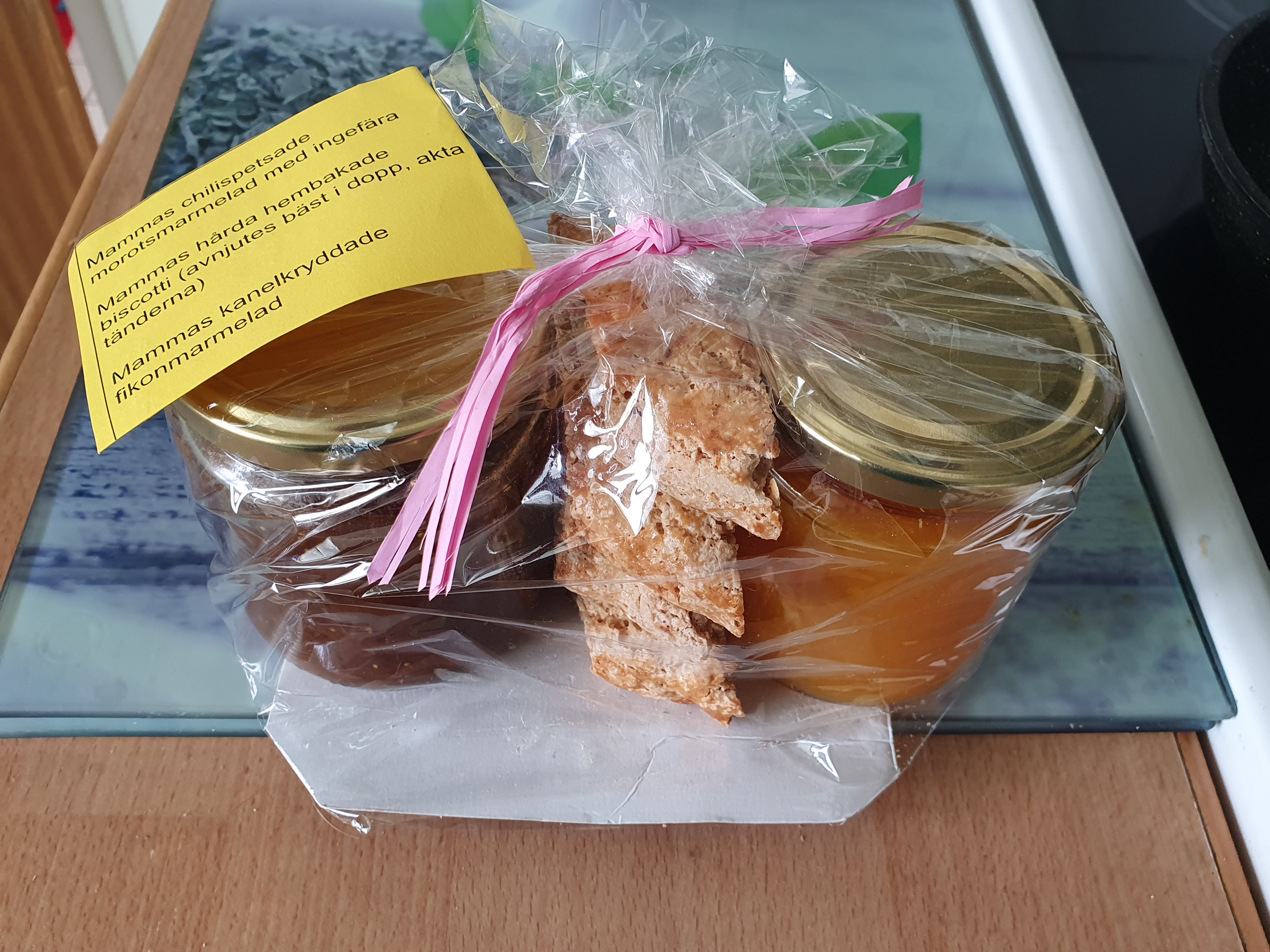
ps. One of the graduating students and his mom made a “farewell and thank you” jam kits with for all the teachers! ^_^


20200606_091634

A lecturer, a head of the department and a professor emeritus walk into a student bar…

The barmen asks them:

-So, have you read the latest thesis published by your department?

The lecturer says:

– I skimmed through it.

The head of the department says:

– I just don’t have time! I only glanced at the conclusion.

The professor emeritus says:

– No.


Just thought I would leave here a link to the thesis that me and a friend made when we finished our design education:

The saturation of the Steam platform game market and the noticeability of the saturation by Steam users.

Happy drive song

♪ ♪

If you made a new, nice asset,

texture or documentation –

Put it in the drive!  Put it in the drive!

♪ ♪

In the cloud they will be happy,

in the cloud they will be safe –

Put it in the drive! Put it in the drive!

♪ ♪

So the hours of your work

do not vanish into smoke –

Put it in the drive! Put it in the drive!

♪ ♪

So you don’t make friends depressed,

to avoid yourself distress –

Put it in the drive! Put it in the drive!

Put it in the dri-i-i-i-ve!


In memoriam GGC2018

Art, con-, con art

Conferences, conventions, congress, convergence, concord, conversations

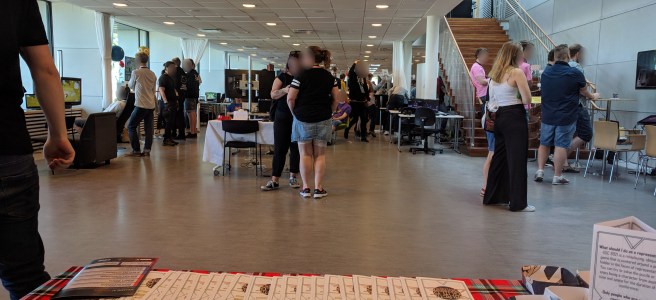
One of the best opportunities to learn during education on Gotland is the conference organized by the faculty. I have already discussed this event once in my recap of the first year, but it is a gift that keeps on giving (no sarcasm here). Unfortunately, most 3rd-year students are too distracted from really utilising this opportunity due to the thesis writing. The 2nd-years, on the other hand, are presented with a problem to solve: how to make a product with the course requirement in mind, that would also be good enough to pass the requirements of the exhibition part of the conference?

One could disregard the conference, do the course assignment and that’s it. Or one could make an interesting thing for the display and to woo the judges/industry representatives. Or one could try to juggle both balls. And the majority of students decide to try their juggling skills.

The result is the pressure of a hydraulic press, a certain amount of stress, high probability of drama within the groups and a bunch of demos (because that’s what you are supposed to do for the course) that will most likely not be continued to work on. Some wounds might be soothed by a token reward at the end of this crazy race. But one has to wonder how it feels when you end up walking away empty-handed despite your creation not being a complete piece of garbage?

So, if you walk into this challenge as just two people, an artist and a designer, what is a developer to do? Analogue games and role-play are a way to approach this. And no need to look for a competent programmer which are surprisingly hard to come by.

An interesting thing about role-play is the influence over the game by a GM (Game Master; or DM for Dungeon Master). All you need is an imaginative person with a certain level of acting skills and anything can be turned into a source of entertainment. And in this way, a little conference can indirectly show what is has been happening at events like E3 and similar Cons. A company just throws into a room someone who is good at playing (no pun intended) the crowd. This is how they are able to walk away without showing any legit game footage or giving any detailed information about their project. Only the hype created by a talented GM.

So yes, GotlandGameCon is a great teaching tool. Almost no cons about it.


Corelan

Corelan was a middle-aged man of a medium build from a bigger Molrava city.
He got stationed to Trell after he accidentally let through a cart filled with goods among which were several barrels of rare delicate spices somewhere from across the Endless Sands. The outbreak of conflicts based on angry cooks and housewives fighting over the piquant spice turned the town into complete chaos for a week. The head judge of the city was so fed up by the cases of destroyed kitchens and sabotaged dishes that the spice was banned. Corelan petitioned to get transferred to somewhere where people didn’t give him the stink eye because he simply let a merchant with some ground herbs through the gates.

Interactive Storytelling 2018

WoW raiding as an analogy for the game development process

Recently, a couple of fellow fresh graduates and myself observed that applying for jobs is similar to applying for a place in a raiding guild in World of Warcraft. This made me reflect on how this can be taken further and that there is a similarity in the experienced frustrations when it comes to making a game in a group VS the frustrations of raiding in WoW.

Back in 2013 Blizzard claimed (source) that they have reached the number of 100.000.000 created accounts. This doesn’t necessarily mean that so many people actually played the game (an account ≠ a player) but it is likely that the person reading this blog post has at some point played WoW (also, a WoW player ≠ a WoW raider), but has never developed any kind of game. And if the reader falls into all the needed demographics they will probably have a laugh from reading this.

So, allow me to name some all the things I can remember, that made me roll my eyes in a WoW raid. All of these frustrations can be translated into the frustrations of a game dev. Let’s go!

  • people aren’t on time
  • people don’t notify their absence
  • people have no consumables
  • people have no gold for repairs
  • people stand in fire (an old classic)
  • people can’t aggro packs properly
  • people don’t grasp the concept of “ready check”
  • people don’t understand that you can’t summon the repair mount inside
  • accidental pet aggro
  • accidental bloodlust
  • nobody brought a feast for the people without their own food
  • multiple butlers spawned at once
  • all butlers on cooldown
  • someone hearthstones to the bank before checking for a warlock in the raid
  • warlock doesn’t give out healthstones
  • rouges wasting time by refusing to die
  • your internet dies
  • the power is out at your place
  • the power is out in your town
  • the power is out at your entire island
  • the subscription runs out
  • water/coffee/tea/alcohol spills onto the keyboard
  • someone’s wife goes into labour (true story)
  • you didn’t manage to finish the content before it became outdated

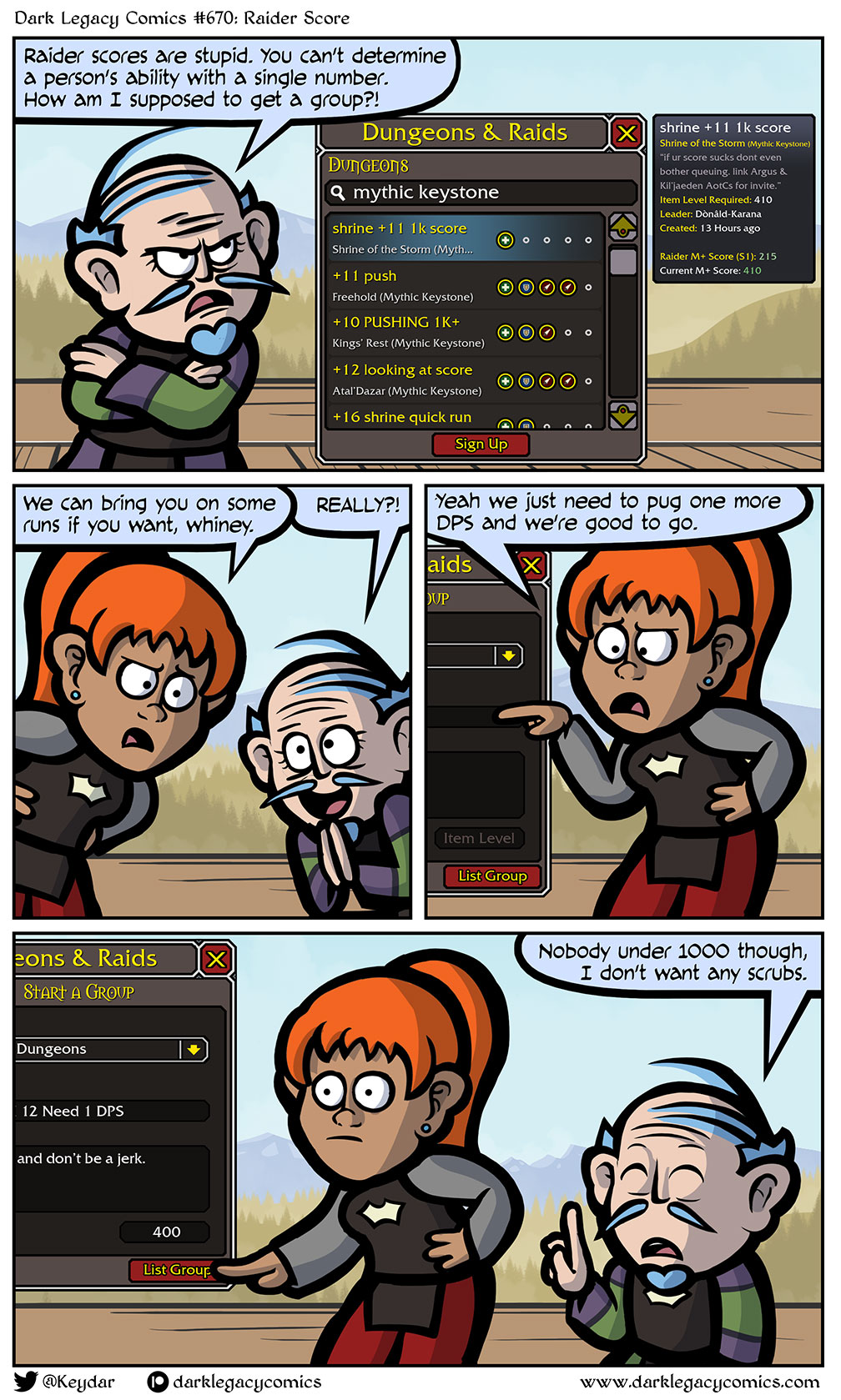
And a Dark Legacy page on the subject of “need the exp for a job, but need a job for the exp”.

DarkLegacy670

Гуманитарные будни

Линкедин, фэйсбук, нэтворкинг.

-Не нужен ли вам такой работник?

-Ну, а что же ты учил? Да, ты работать должен был!

Образованье нынче в моде – всем айтишников гони.

А человеческим наукам ни проехать, ни пройти.

Для парадов и для лоску, лучше б, был бы ты побрит.

А детей учить нам станут Святой Дух и замполит.

3-year milestone: my education’s post-mortem

RealProfessionalThree years ago a certain teacher in game design told the students in front of him that they will hate games once they are done with the education… The truth is that I, personally, already felt pretty neutral towards them even back then. But the process of making games – now that is a different story altogether.

It’s time for a small post-mortem of the experiment called the game design education that I put myself through. In short – it was a conflicting, but fun* experience.

The process of making games remains a majorly practical activity, while the nature of academia is to observe and to discuss. These two natures create interference with each other. I can’t recall all the times when someone exclaimed “I wish we’ve had more game design theory!” during a production cycle, or “I wish we’ve had more time spent on making games!” during a theoretical course. In the end, there was neither enough production or theory to satisfy everyone’s demands, I think. But, in all fairness, we did get to experience both to a certain degree.

Some people wanted to have more time spent on learning the software tools, while others considered learning the tools a waste of our time since most of that can be done at home via video tutorials and such.

The teachers recommended to use Unity, but the majority used Unreal anyway.

Programmers and artists hated designers and managers for not knowing what to do, while the designers and the managers hated the programmers and the artists for not cooperating.

Finally, in the end, we all had to engage in the academic work which had nothing to do with the game development what so ever.

The final verdict: ¯\_(ツ)_/¯

And now I’m off to search for a relevant job in the world of ludicrous entry requirements, junior positions with a minimum of 1-2 years inside of the industry already, and an uncertain future for the games in general.

This is gonna be fun*!

*the definition of “fun” is left to the readers own interpretation according to any prefered game theory.