1-year milestone. Part 1.2: Ideas and Concepts.

One of the most important things in this education, besides working in the groups, is how you handle the ideas. I have to say that being creative is something I missed during my time in linguistics. While an open mind was welcomed, the creativity was highly impaired. If you couldn’t support your train of thought by a reference to already existing works, you’d have some hard time. Only a tenured professor who is steps away from retirement was excused for having crazy ideas. But here, anything goes, while you can communicate it properly. I’m an artist now! So, let’s talk a bit about how I view the ideas and how to handle these fragile things.


A simple image is worth a thousand words. Everyone needs to take up a pen and a paper and start sketching. Don’t say that you can’t draw. Cavemen couldn’t draw either but it didn’t stop them! It doesn’t matter if it’s just stick figures, we aren’t putting your work on a display stand. You just need to get a message through and a crappy picture is usually better at this than a wall of text or works are a great compliment to the wall of text.


Forming an idea and shitty ideas. Let ideas be born. Slowly, but surely. Any idea, no matter how laughable at first, can be iterated and moulded into a genius by a right set of hands and minds. There are rarely bad ideas, rather there are bad interpretations. It is a typical case in the movies when someone does something stupid and then explains it by saying “It seemed different in my head…”. This is the point of iterations, the process of changing and adjusting until the garbage is away and only a great core remains. And this core can be executed with ease. This is especially important for the artists and the designers.


Single ideas and surges of ideas. This ties together with the point of carrying a notebook of being able to note down things at all times. You can be anywhere when diarrhoea idea strikes. And if you are in the situation where you can’t stop to ponder on something, you need to take a note of it. Even more complicated is the case of having a surge of different thoughts that all have a discussion value. At this point, all you can do is keep putting down the strings of thoughts on paper with as many details as possible in the hopes of being able to decipher them later when the storm calmed down. And don’t expect to understand everything you have written down either.


Creative drunk (with a disclaimer). I’m not advertising alcohol or consumption of any types of drugs here. However, if you find yourself in a state of a clouded mind and suddenly realise that you are pondering some weird idea – jam it down on paper or tell it to someone who is sober, to remember it for later! The ideas of a drunk mind are the things that might never come to a sober mind and this needs to be examined. Not only could it be a crazy idea, but it could simply be something you didn’t dare to voice while you were clearheaded. “The drunk mind speaks the sober heart”


The choosing of an already finished concept. Warning: rant and a high level of saltiness! One of the weirdest moments in the education were the 5 minutes we were given to choose one of the finished concepts for Shoot ‘em Up game. One of the biggest opportunities of the first year was squandered away, sadly. Of course, people would go for the most articulate and flashiest concepts for obvious reasons but that isn’t the point here. I commend the groups that did their job well at creating a solid idea. But there were so many other ideas that got thrown into the void at a whim.

Let’s examine the result of this scenario. We ended up with how many Witch, Fish, Echo games? It was excruciatingly boring to sit through the mandatory presentations where you get to see the same concept over, and over, and over again. Furthermore, it created an unnecessary scale of comparison of the same games. Don’t you think it was painfully clear which Witch (ha!) was the best? It was. Do you think that other teams with the same concept weren’t aware of their inferiority? They probably were (and if they weren’t, God bless those innocent souls). How do you think felt the people whose concepts weren’t picked? Probably like crap. As a result – unnecessary mental burdens everywhere.

What was to happen if the concepts were to be simply drafted? People who got the “good” concept could have made their games while focusing more on the production. The teams of the other concepts would have been faced with a challenge of interpreting the less articulate concepts into a proper game. Isn’t that a great exercise, to take someone’s embryo of an idea and realise it into something fully formed? That way there wouldn’t have been any unnecessary comparing of games. Everyone would have been happy to see their concept being realised. And watching the presentation of the progress in production would have become something to long for. There are two other key experiences that were missed by so many groups because of the different scenario playing out, which I will bring up next. An overall great opportunity for a unique high-value experience for every group wasted, in my opinion.


Letting go of your idea. Partly continuing the rant above, something that all needed to experience, but didn’t. Once you have formed your idea and it is handed over to someone else it is super important to let it go. The people will examine it and create something they see through their own eyes. Which is why I think, it is irrelevant to ask someone “is this how you saw this game?”. It doesn’t matter how they saw it, they weren’t the ones making it. As the concept is handed over into other hands it stops being your concept. All you have left is an echo if the idea that can manifest as basically ANYTHING. Learn to let go of an idea and most certainly don’t try to impose your vision on the team working with your concept. Same goes to the team working with the concept, don’t try to follow the vision of someone else to the letter. This is now your playdough and you get to do what you want with it.


Deconstruction of a concept. Another thing that many people didn’t get to experience was the option of taking a badly formulated concept and recycling it into something good. I am a firm believer that there are no bad ideas, only bad interpretations and executions. When faced with a poorly formulated thought the only scenario is to search for the essence of the thought in the text. Some repeating pattern, a word that is used many times. Searching for a diamond in a pile of refuse can be quite an adventure in itself. And once you’ve done that and produced something – you will feel great. And chances are that those who didn’t manage to deliver the idea 100% will be also happy at seeing their vision interpreted and brought to life. I know, I would be happy for sure!


Getting burned once might impair the creativity. Just like in real life getting burned once makes one avoid fire. Someone, who’s idea was bad might not ever push themselves into creating a new idea. But to approach this problem you simply need to reassess the situation. Reflect on what went wrong last time and take it into your calculation. But just because you failed last time you shouldn’t tune down on your ambitions, rather you should scope them better. To under-scope could be as harmful as to over-scope. Search for the right balance. And just as we were told in the lectures, how many games did those guys from Angry Birds made before finally scoring big? It’s about failing and learning and failing. Not failing, getting crippled and not wanting to fail again and thus not try properly.


Embrace the games in their creation (a.k.a. playtesting). Once the journey has started it is important to keep the imagination engine well fed. Once the playtesting begins and you get to experience the creations of others don’t be scared away by these rough-cut diamonds. While some devs are eager to show their progress, other are more reluctant, almost uncomfortable about their babies. Don’t flee at the sight of something that has no graphics, or looks wonky. Get the feel of it, talk to the creators, ask them to elaborate on what they are doing and what are they planning. You can usually get a good picture of their ideas even from an alpha build. And they will appreciate your interest, I’m sure. It will also help them since they will ned to articulate their plans and destinations and might realise flaws in those. So, if you playtest – playtest politely, but playtest hard!
1-year milestone. Part 1.1: Education and The Calling.

So, the grand Post Mortem begins! I start this first post (excluding the introduction) with my opinions of what sort of education did I get myself into. Onward!


The 4 courses and their synergy. I am happy to have been one of the first people to try the new branched out program in Game Design at Campus Gotland. I have heard only positive things about education in games on Gotland. The change of format was even more appealing to me because it was the first year the GAME section decided to lecture in English. But one must admit that this wasn’t all sunshine and rainbows. While the Programming and Art directions felt as already well-formed courses, the Design branch, as well as Project Management, felt like they still need more work on them. Which is understandable, this is something new for the GAME section. I’m sure that this year has given them a lot of feedback and, hopefully, in the future things will only get better. I can see a clear intention for the synergy of the courses to reflect the synergy inside the industry. The only thing missing at this point is the music branch (perhaps a future prospect? Or a collaboration with the Gotlands Tonsättarskola that is just next door from GAME?). While the intention for the synergy was there, the disharmony dominated loudly. People were taught contradictory thing in different branches. There was a lack of clarity about our rolls. And the biggest confusion was mainly caused by the names of the courses themselves. I will go into this in more details later. But as I said before, the teachers showed their interest in our feedback and hopefully, we were effective experimental rats for them.


Are these courses for people who play games? Yes, mostly. Can a mere mortal take these courses? Yes. In the same way as someone who originally wasn’t interested in reading can take a course in, say, poetry. It doesn’t mean that you can’t but you will find yourself at a giant disadvantage. The problem of this lies in the fact that here we don’t play the games before we make them. We go directly to the step of the creation. So, even though having 10k hours isn’t a must, it is sort of a hidden requirement. And the genres, lingo and references clump together into a gargantuan ball of information that a person with no experience of playing games will not be able to swallow. Now, if you are determined to fight through this obstacle, kudos to you, start wrecking up your hours. But people who think that they can make games without having played games are going to have a hard time.

Another side of this coin is the young people who come here precisely because they love to play games. And here is the kicker – “loving to PLAY games” doesn’t equal “loving to MAKE games”. If you happen to have 10k hours in Dota or Lol or whatever, you might still be clueless about the creative process of game development. So maybe turning to e-sports is something you should consider first before going into development?


Public opinion about digital games. Can you imagine a situation where a doctor or a civil engineer would find themselves embarrassed to tell in public of their trade (and I know, you people can probably concoct such a scenario…). But let’s face it, this isn’t a prestigious line of work we chose here…not prestigious for now! You might not have experienced this directly, but I know I have. My family supports me and my life choices at its core, however, this core is well hidden under a thick layer of ridicule and disinterest. Don’t be ashamed to face the fact that you are making games. This industry has millions or even billions of “rupees” circulating in it. There are hundreds of amazing people working on creating wonderful experiences. The person who sneers at the computer games is usually the same person who enjoys watching a bunch of dudes trying to kick a ball through 2 metal polls for 90 minutes. Their inability to see the simplicity of the rule of play is their own loss. No point to be ashamed of games, they are a part of our lives. Hopefully, we can be the people who will help the world to finally embrace this truth.


The ability to write a text as a sign of being in the right place. From my experience in another academic field, I can now state with confidence that the way to judge your happiness with the studies is by the amount of effort and time it takes you to write the texts needed for the production and/or examination. Now, don’t panic! This is more of an indicator of a definitive positive thing rather than of a negative thing. I know I liked a lot what I studied before (language and linguistics) but every written assignment was a small nightmare. And some assignments are more exciting than others. But if every deadline sends you into a cold sweat, think on this.

Then there is the case of the last-minute sprints, which is ok. I have seen a lot of people deliver great pieces of work in the last couple of hours before the deadline. High adrenaline “junkies” can also be functional members of a team, if you are aware of their habits. I am partly guilty of that too. Actually, a lot of talented individuals are the types who do everything last minute. The important thing is to manage things BEFORE the deadline.


Sensing a new calling. The making of a game involves several different fields of expertise, which is the point of this education. And some of us might sense that there is something they want to do that isn’t the thing they are doing right now. This can be a different aspect of the game development (a programmer who decides to become an artist instead), or the same discipline outside of game development (an artist that likes drawing, but not drawing for games; a programmer that doesn’t like coding for games but still likes coding; etc.). And some people simply understand that they are in the wrong place completely. As mentioned above, loving games doesn’t necessarily translate into loving to make games. Help your fellow students understand what they want to do in their life, talk to them about how they experience education and the game production cycles. Don’t let people get trapped in something that doesn’t bring them joy. They waste the precious time of their lives. These people will not be able to make games that bring other rich emotions if they aren’t finding meaning in the process of creation. Or … are they able to? Perhaps misery can create a masterpiece? But I think that I want to be happy doing what I’m doing, not unhappy.


International students. I know that I was excited to found out that education was given in English not only because I love that language, but also because that opened doors to the prospect of meeting people from faraway places. These people bring with them a unique perspective and can be a great boon for your teams. But, to tap into that potential, you need to establish the boundaries, of course. Someone from a foreign place who decided to come to an island somewhere in the north of Europe can already be assumed as a daring and an open personality. Talk to them about as many subjects as possible if they are willing to discuss those. Their cultural baggage and their unique perspectives can serve you on your way to a great game. Also, they might have characteristics that you are lacking due to your cultural heritage. For example, Swedes aren’t generally people of confrontation, they tend to avoid open conflicts even though sometimes a head-on approach is inevitable. Use each other’s strengths.


The confusing titles of this education. I must say that this has been one of the most annoying things EVER. While calling these educations Game Design might have worked when there was only Art and Programming, with branching out into Design and Project Management this is now chaos and confusion reigning supreme, to say the least. And I hope this will be addressed as soon as possible.

Before I am condemned about this I will paraphrase Socrates “I know nothing”… but here are my two cents on this, ha! I’m sure there has been an ongoing discussion among the staff of GAME about this but I just can’t let this pass. Have you noticed how BROOOAD and WIIIIIDE the term “design” is? It applies to almost anything. And when you decide to bring in the actual designers into this, this term can’t continue to function as an accurate description of educations. I know that this might be (and most likely is) a bureaucratic terminology problem within academia, so I will just give a translation/clarification for myself here. Here are the four branches in the language that is understandable to me, a simple plebe:

  • Game development and Graphics/Art
  • Game development and Programming
  • Game development and Production (Why the hell are we calling people “managers” when this isn’t the term used in the industry?! ARGH…)
  • Game development and Design

But wait! Aren’t we all designers? Yes, we are. But if you haven’t noticed, there is a particular job title in the companies called “Designer”. There is a reason for that and not just any artist or a programmer can get that job. I will explain this in more details another part of my blog, so just bear with me. Suffice to say, such confusion should not arise in the first place.

Teachers, keep your confusing names for the paperwork, but please explain this to us in details the first time we walk through the doors.  Okthxbye, moving on…


Iteration, feedback, salt. In this line of work based on the iteration, the feedback is everything. And if you ask someone for their opinion, then you better prepare your anus. Not necessary because they have something bad to say, but because we all give feedback in our own way. Some might be polite and not point out the flaws directly, while others will tear your creations apart. A criticism that is objective and bases itself on some evidence or solid arguments is a fair play. And what you need to learn is to distil the messages to their essence regardless of the form. We aren’t 5 years old here, so don’t get fucking salty about someone pointing out flaws in your creations. Something that isn’t obvious to you might be apparent to another individual, that’s the whole point. Grow the fuck up! And by the way, you aren’t forced to follow the feedback. It’s your creation, you do what you think is best.


Carry a notebook. It’s that simple. No hidden message here. Just make a habit of writing down or sketching your ideas to return to them at a later point in time. This will create for you a backlog of interesting thoughts that will otherwise disappear.

1-year milestone. Introduction.

Hello and welcome to my blog!

My name is Gleb and I recently finished my first year at Uppsala University in Bachelor Programme in Game Design. During this year I got to meet a lot of different people and experience a lot of things. The most important thing I realised was that I made the right choice by deciding to embrace my passion for games and wanting to create games for others.

So, what is the point of this blog? This blog series is a reflection, a year-long Post Mortem if you’d like to call it that way, where I map things that I feel are important to understand and be aware of when one is journeying towards the world of game development. This is MY roadmap, something I create so that I may return to and remind myself of these important things should I lose the sight of this road.

What can you expect to find here? I’m using the word “experience” and here is a good definition for this word:

-practical contact with and observation of facts or events.

This is about observations of fact, events, but also of similar behaviours in different people. If you pay enough attention, the patterns with emerge! I love the word “pattern”. If I reach the end of this personal project, you will understand why 😉

I plan to tackle on several topics in a series of blog posts, starting with the general thoughts about the past year, moving on to the experiences of working in a group of people from different disciplines, and finally a discussion of the role of a designer in the group (I’m a designer!). So, basically, I’m slowly zooming from a very broad topic to a very specific one – what is my job in a group that creates a game? And I will try to structure this discussion as best as I can, but naturally, some questions can be taken to several areas, so do take this with a spoon of salt. I am also discussing this from my perspective, and I know there are other perspectives out there.

As you can imagine, these are my opinions. I am not trying to convince anyone of some kind of truths and I am not any sort of higher authority in these questions. If you are one of my fellow students, I invite you to reflect on your own journey and perhaps clash your opinions with mine or show your support of these opinions. If you are someone, who is about to start learning Game development, you might find some useful information that I wish I knew when I started this education. If you are someone who is already experienced in this field, then you might not find anything new here at all and that is fine too.

So once again, join in! Perhaps after I’m done with all I want to say, I can make another section where I bring to light your perspectives, experiences and revelations. Whether you are an artist, a designer, a programmer or a producer (project manager) – any feedback is welcome!


All this writing was done while listening to THEFATRAT. Shout out to my Guild Wars2 guilds where someone linked those wonderful mixes! All of the [WIPE] and [PLS] – you guys are great!

Random stuff: white boxes and Black Mirror

So, this is my first blog post outside of any specific assignment. In order to practise my writing, I will simply spew out some nonsense about the stuff that has been on my mind lately.


Whiteboxing

Recently, my first team finished our first real project. It didn’t turn out as well as I wanted it to be, but I learned a lot of things. One of those things was the realisation that whiteboxing isn’t something that comes naturally to everyone.

What is whiteboxing? Basically, it’s a process of creating a prototype with only simple shapes and the absence of colour. The person who is creating such a prototype uses the simple shapes for projecting their vision and ideas. But it is also useful if you don’t want to have any specifics about the thing you are prototyping. It leaves you with the freedom to imagine and swap details as you desire.

Why am I talking about this? Because learning and understanding the principle of whiteboxing is vitally important in creating the games. There is also a practical use of this. A white box is a signal for the team “I am a placeholder! There must be something here!”. A desire to have some kind of pictures, a placeholder art if you want to call it that way, is a treacherous thing. It can stay in the prototype for a long time and also send wrong signals about what should actually be in that place (talking from the experience I got during my first game production)

So train your imagination early on to see things where there is nothing but a white box. A white box can be anything you want it to be. As an example, here is an early prototype of Ori and the Blind Forest.

Black Mirror

I recently finished watching Black Mirror series and it was amazing. Here is a short description from Wiki:

Black Mirror is a British science fiction television anthology series created by Charlie Brooker and centred around dark and satirical themes that examine modern society, particularly with regard to the unanticipated consequences of new technologies.

So, I’m not gonna talk about social commentary, society and yada, yada, yada… I just want to admire the design choices of the world created in the series. The amount of thinking that was put into going deeper and deeper into the technological dystopia. And then into making it fit the TV-screen representation. Every episode amazed me in this regards. I definitely recommend watching this series, if you are looking for good execution on technical level, or some thought provoking statements.

Game Production Afterthoughts

last scene 2

It’s over. Our ten-week march is over and we have a game. Or, at least, something that constitutes as a game? I am being super harsh here. Do we have a game with a start and an end? Yes. Can you finish the game? You could if you are very good from the start. So, ok, we have a game. Could it have been better? By a lot. Yay! We have a bit of undercooked game. Not bad for a bunch of first timers-ish.

For those of you who have no idea about what is going on – this post is an aftermath of a group of first-year students creating a game together for ten weeks. This week we have presented our game to other students and got to see what they have.

So, let’s see what went good and bad in our production process.

The good stuff

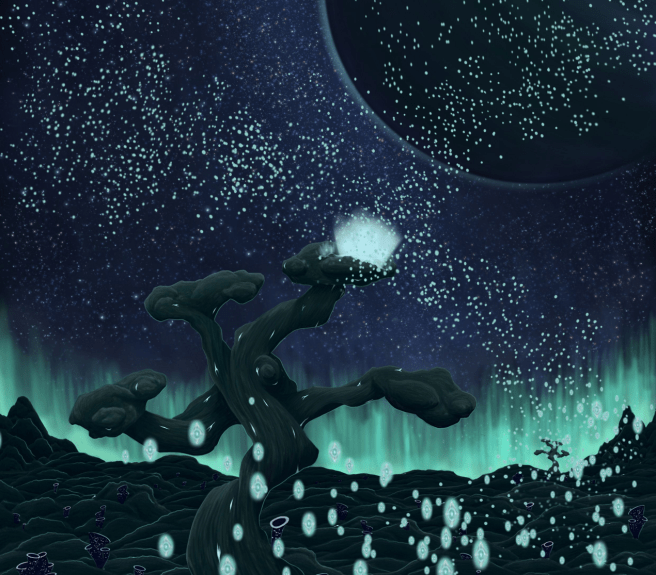
The narrative and the establishing of the theme and mood: In my opinion, this was by far our most important effort. The fact that we went out of our way to think about the world in which the game was taking place in details was very important. The concept we received was too alien, too unfamiliar. The time we put in explaining the motivation of the avatar and showing the world she lives in was a solid decision. Have we actually succeeded in that? Who knows… But most of the games I played during our release/playtesting day were lacking in that department. The games were either established in a known world and for that reason skipping the explanation of it. Or they were not explaining their non-mundane setting.

The art: when I mention the art, I don’t mean the individual skill of our artists. It would be unfair to say that the art of an established artist is good while the art of a beginner artist is not that good. This isn’t the point. The point is the ability of our artists to create the ideas we had for the visuals of our game and syncing their styles in a way that made them fit each other. This is what I mean by the art being good – the effort and work the artists put into aspects like cooperation and style synchronisation.

The not-so-good stuff

Agile Scrum: we sucked at it. No delicate way to put this. We were awful at planning properly what and when we should be making. We were awful at keeping track of each other’s work. We were awful at keeping deadlines. I personally feel that this system, in the way we were shown and asked to do it through a template, was too unfocused. It was too much of a relic from previous education. Too specific in some unimportant aspects while being completely unhelpful in other important things. If it wasn’t a required element for the course completion, I would have disregarded it completely. The main purpose of it, from what I could gather, was to teach us about time management and to know our own time frames. And there is a grain of sense to that. But predicting time frames never works as you hope it would. So, we attempted to predict something that is famous for being horribly unpredictable.

Playtesting: this one is my personal responsibility and I  must say that I failed it. I could say that there were other factors to this, but my fault is not voicing my concerns early on. This resulted in playtesting reflecting a Waterfall method rather than Agile. Stuff piled up and waited for a fix instead of getting fixed on the go.

Overconfidence: we were too full of ourselves and it exploded into our faces. Never wait until the final days to implement something. Any implementation creates a side product of bugs. Implementation of a bunch of stuff last minute creates a legion of bugs. Those bugs riot and take your programmer as a hostage and demand to cut things for the release. An ugly scenario. I hope I will never have to relive this situation again.

All of this was a valuable experience. The experience of creating and building a game. The experience of the dynamics of a development team. It was both fun and not fun, satisfying and disappointing. And most importantly this was just a school project, no better place and time to fail and learn from our mistakes.

Art by Niki Kubasova.

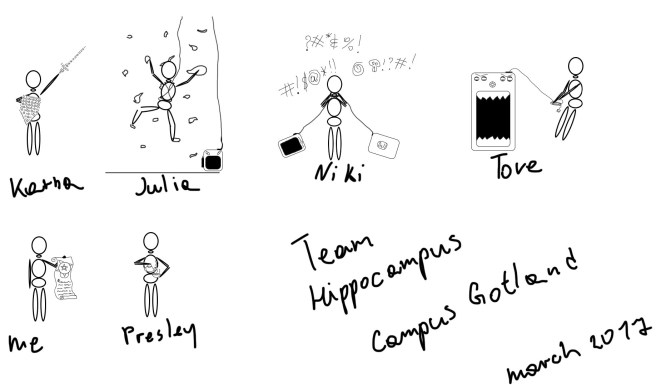
And here is a doodle of my team Hippocampus. Thanks for the time we spent together and the best of luck to you all! =)

team hippocampus

Game Production Diary 5

For this week’s post, I’d like to write about my design of the boss arena, the interior and the end of our game.

For those of you who didn’t read my previous posts, where I think I mention the general ideas behind our game: my team is designing a game that will consist of the only level. Basicly, we try to deliver the whole narrative in one experience. Because of that, we need to finish our story after ending the only level of the game. This calls for more detailed planning of how the area where you fight the boss does look like.

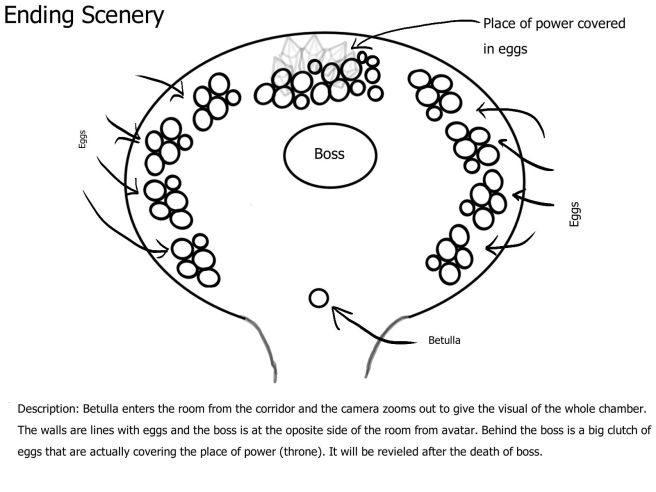
ending_scenery_jpg

Here is a sketch I made to show my team the thinking behind the boss encounter environment. This sketch will be later used by the artists to create the arena of the boss fight and to explain to the programmer the behavior of the boss and the reasons behind my ideas (for example hitting the wall or the egg’s spawn).

So, we have a circular arena on the top a crystal tree. The visualization of this is tricky since we are technically inside the tree, but let us ignore laws of physics and space. In this room, I placed the throne that is the final destination of the avatar. Then I tried to show that we will cover the throne with props. The throne is going to be revealed after the boss dies by destroying props. All of this connects to the scene that player sees in the beginning of the game where the avatar leaves an old, depleted thrones behind in another tree.

With this we show the player the begging of our story, it’s progression via player’s play and, finally, how the story ends and resolves.

I find that having a miniture story shot ’em up game that contains a closed story cycle is an interesting idea. It’s so easy to create a story but only manage to introduce the player to the first chapter due to the production time limit. When you are a student it’s easy to overscope.

Please note this is one of my older artifacts, not something that was done directly this week 🙂

Game Production Diary 4

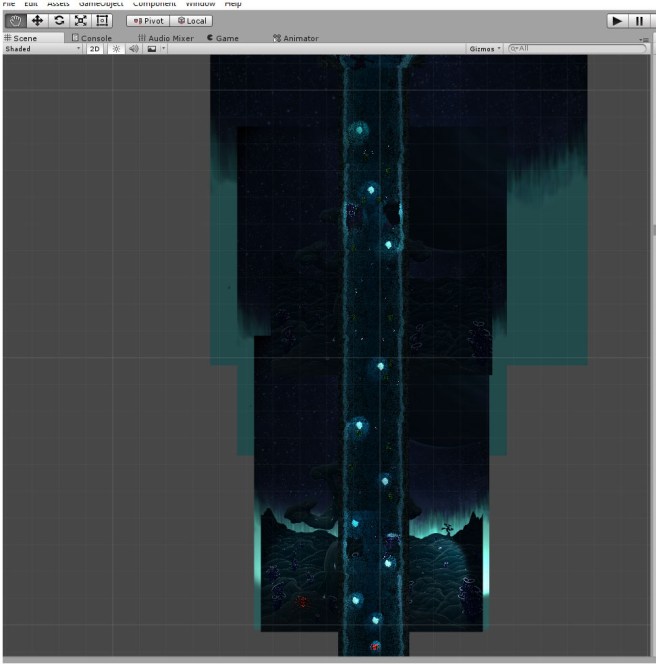
This was the last week before our beta demonstration. We finally got together all our assets into one large pile to get them into a comprehensive experience. I finally got some time with everything we have. And the construction of the level turned out to be an interesting thing to do (I never doubted that it will be).

untitled-1

I had only a general idea of how to structure our level. The task we have allows us to create games with only the first level. In other words, you get to play a level and see that there is more to come but here is where the game production ends. Our game, however, is a whole game in one level. So, we need to try and create an experience that feels complete. The progression curve of the challenge must feel natural. And so I set out to try and deliver this curve. I choose a simple method; add more monsters as the player reaches closer the end boss. One might think that this approach is fool-proof. But, later I realized that just filling the level blindly with mods has a flaw. I had no track of the time it takes to reach the boss. And furthermore, I want to be able to finish the level and the boss in the time given for beta presentation. And just like that, I ended up taking time of my own level run, trying to figure out how much intensity in mobs should there be. In the end, I settled on the time for a perfect game run to take around 3-4 minutes. This leaves a good margin for a run that is relaxed, given that the player knows the structure of the said level. This whole ordeal made me want to research a bit on how to measure the time resources from the designer perspective. Can a good game fit into a time that is under 5 minutes? How long is an average shoot ’em up level?

Game Production Diary 3

For more information on my game, please visit my first diary post, where I describe in more details the game we are working on.

For this week’s blog post I would like to discuss the incorporation of the same visual element in different places to intensify the aesthetic side of the game.

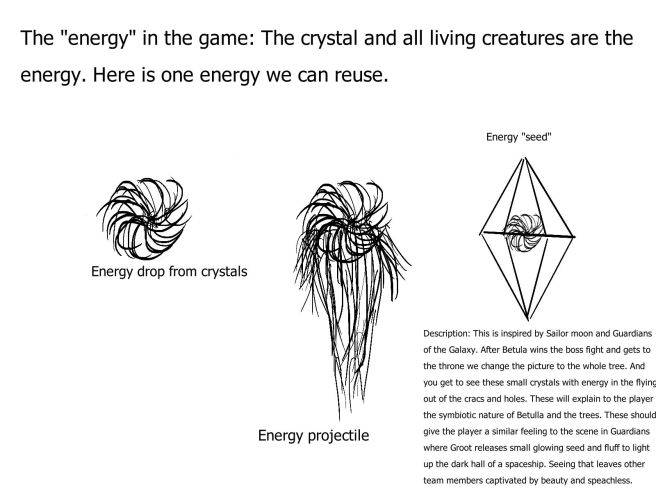
So, according to the narrative that we try to create, energy is everything in our game world. All living creatures consist of the same energy: the trees, the avatar, the enemies. This was the main reason for us to make the health of the avatar its ammunition. And it was during this week that I suggested using the same sprite for pick-ups and projectiles. Also, for something else, which we might not get to in the production process.

So here is a sketch of how I imagined this. To the left, we have a sketch of an energy flux players can get from smashing crystals while playing. And in the middle, I tried to sketch a projectile that would use the same sprite as the base. We will have to make it more projectile-like, but I hope you get the idea. The last picture is more narrative heavy and has to do with the ending for our little game. You can read details on the sketch itself. It againenergy_concept_jpg.jpeg incorporates the energy flux sprite. What is the point of all of this? To enhance the filling, that everything in this world consists of the same matter.
Another theoretical step towards improving the aesthetic experience of the player is to make the avatars glow as she has more or less energy and when she picks more energy drops. I hope, that these elements will tie together nicely into a visual feast that I so desperately want our game to become.

Game Production Diary 2

This week all the groups presented their alpha builds. It was an exhausting experience to sit through around 20 presentations. But, thankfully, I didn’t leave that torture chamber without some insight about our own game.

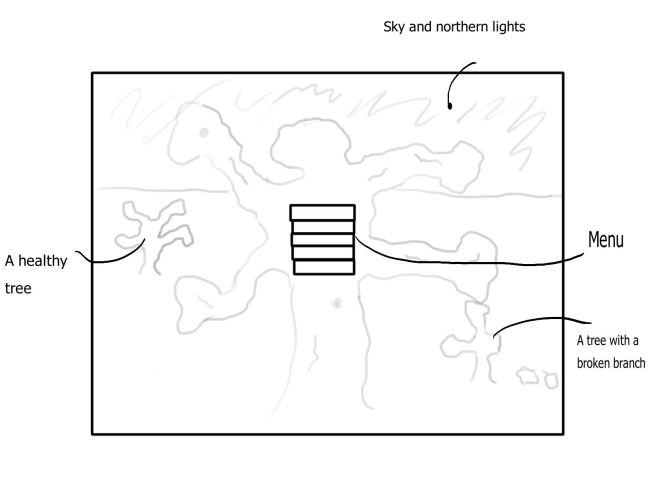
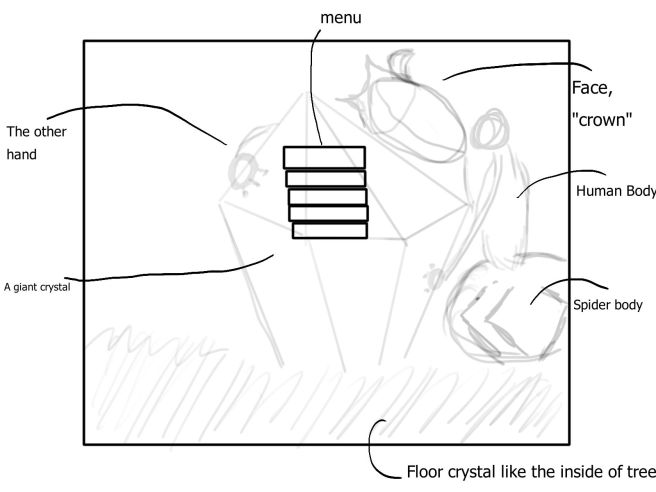
in Game Design, you are always warned about how you will probably never get to build your own concept. But when a concept isn’t perfect, it allows you to pull at one loose string and unravel the whole thing into a lose pile of idea. You can reconstruct the concept from those ideas into something that is now in fact your creation. And that is what we did in my team; we took a wide, unclear world and reinvented it our own way. This allowed us to create a clear narrative for our game, which I think a lot of presentations lacked, as they followed the concept documents without much remaking. So why am telling this? Because I want to show you two sketches of our game menu. The reason for why there are two of them depends on how much of the rest of the game we can produce. And both menus have some narrative value.

Menu sketch number 1

start_meny_version2_jpg

In this one I tried to depict the crystal tree and its surroundings to give the player a better feeling of the world. It shows the structure of the tree and environment that is both beautiful and desolate. This is the menu I want for our game if we have time to make several art pictures that also introduce the player to our main character and the beginning of her journey. But this is a time-consuming process that is heavy on the artists and I am not all too sure they can manage this in time. So, we also need plan B for the menu.

Menu sketch number 2

start_meny_version1_jpg

In this one I wanted to have our avatar shown to the player as an introduction. The avatar is always facing away from the player in the game and that can make it hard for players to connect with her, especially since it’s a half-spider and arachnophobia is a real thing. So, if we can’t make scenes where we show the story of Betulla then we need, at least, to show the player her human side, how she gently touches the crystal, that she isn’t a monster you might think she is.


There is however a huge flaw in this approach – we leave the menu screen as the last thing for artists to make. If we can’t manage the story and must make a menu that shows Betulla, that is still a big chunk of work for the artists as this picture requires a lot of details on artistic level for it to connect with the player.

Game Production Diary 1

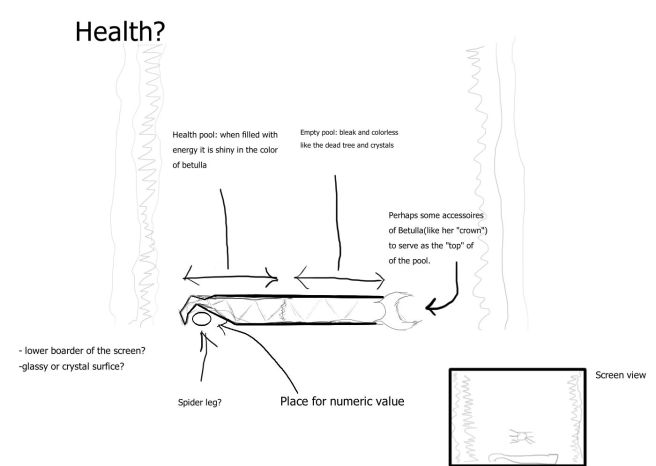
health_barOur project is a shoot ‘em up game. The theme of game revolves around a world of stone “trees” that have a structure of a geode; stone on the outside and a crystal hollow core. All of the creatures of the world live inside of these “trees”. And the energy of the world is in the crystals. In this game the avatar Betulla, a mix of a spider and a humanoid, climbs the inside of the tree trunk in search of places that are concentrations of energy.

The sketch you see on the screen is my attempt to show my team how a health bar in our game can look like. Disregarding the awful visuals of it, as I am not an artist, there is actually a lot of thought put into this. Let’s go thought different elements and my thinking:

-The positioning: The edges of our screen (as seen in the drawing) are filled with the edge of the tree trunk. So, if we place the player’s feedback outside of the tree it will shrink our playing space even more. It makes more sense to place health bar at the bottom, especially since the avatar can’t walk back down the tree in our design.

-Player feedback: In our game, we decided to make the health of the avatar the ammunition. This let us to the concept of “energy is everything”. You consist of this energy, you use this energy as the weapon. This would require a very dynamic meter that can fast reflect the change in the resource. This type of bar is easy to use as both a health meter and ammo meter. However, there is still space to place a numeric value for people who prefer a solid information instead of abstract symbolism.

-Aesthetics: I can poorly capture the aesthetical possibilities of this sketch, but I can try to explain what I wanted to show. To me, it is important for the health bar to be associated with our avatar. I tried to do that through turning the left side of the bar into a resemblance of a spider leg. This is the lowest life point, it is narrow, this makes me feel the accent of how little health you have. The right side in my drawing has a “cap” that can make connection to the avatar even stronger, like an object belonging to the avatar or the shape of her hairdo. I also want our health bar to reflect the contrast between the crystal containing life energy and the crystal that is empty.