3-year milestone: my education’s post-mortem

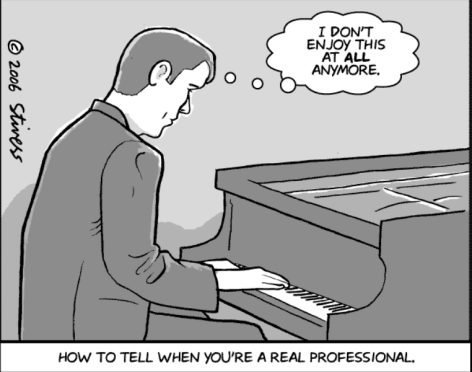
RealProfessionalThree years ago a certain teacher in game design told the students in front of him that they will hate games once they are done with the education… The truth is that I, personally, already felt pretty neutral towards them even back then. But the process of making games – now that is a different story altogether.

It’s time for a small post-mortem of the experiment called the game design education that I put myself through. In short – it was a conflicting, but fun* experience.

The process of making games remains a majorly practical activity, while the nature of academia is to observe and to discuss. These two natures create interference with each other. I can’t recall all the times when someone exclaimed “I wish we’ve had more game design theory!” during a production cycle, or “I wish we’ve had more time spent on making games!” during a theoretical course. In the end, there was neither enough production or theory to satisfy everyone’s demands, I think. But, in all fairness, we did get to experience both to a certain degree.

Some people wanted to have more time spent on learning the software tools, while others considered learning the tools a waste of our time since most of that can be done at home via video tutorials and such.

The teachers recommended to use Unity, but the majority used Unreal anyway.

Programmers and artists hated designers and managers for not knowing what to do, while the designers and the managers hated the programmers and the artists for not cooperating.

Finally, in the end, we all had to engage in the academic work which had nothing to do with the game development what so ever.

The final verdict: ¯\_(ツ)_/¯

And now I’m off to search for a relevant job in the world of ludicrous entry requirements, junior positions with a minimum of 1-2 years inside of the industry already, and an uncertain future for the games in general.

This is gonna be fun*!

*the definition of “fun” is left to the readers own interpretation according to any prefered game theory.

1-year milestone. Finish line.

Since this blog series is supposed to be a map of things that I want to take away with me and perhaps refer to at a later point in life, I should tell about the most interesting thing that happened to me. What pushes a first-year student to write an extensive Post Mortem of a whole year of studies­? No, it’s not an iron discipline or a desire to be productive 24/7. I could be doing other things or not do anything at all, yet something compels me to write down anything that comes to my mind and reach out people with my thoughts and be willing to hear their thoughts. This isn’t a common behavior for me, personally. A week before GGC I felt miserable, yet now I feel more alive than ever. So, what the hell happened?

A short (yet very complicated) answer to this would be this: I might have found God (or maybe god?).

Now that I, hopefully, have you intrigued let me explain with a longer answer.

Ten weeks before the GGC I joined a group to make a game for the expo. I felt optimistic and was full of hopes. By the time the GGC started I was mentally crushed into what I can only call a state of mild depression. All I wanted to do was stay in bed or, even better, get drunk. This state is what I based my concept of group harmony off. Obviously, there were problems in the group project that went unresolved that were influencing the state of my mental health. And I assume that after the project was finished I would have gotten back to a normal state. Then what does God has to do with anything? It’s because of what I felt during GGC and how it influenced me. Let’s start by saying that I thought that GGC was great!

  • I got to listen to different speakers who came to check out student projects. I was especially moved by the example of how games can tap into deep human emotions like grief.
  • I got to see the craft of my fellow students and admire their achievements. I was happy for them being recognized with prizes during the award ceremony.
  • I witnessed that my game that brought me so much unease was recognized as a part of the GGC2017 showreel.
  • And during the GGC I figured out what the problems of our group were. This is important because rather than just moving on, I had objective reasons for our struggles.
  • And when GGC ended I had a chance to talk to many talented people with whom I have barely exchanged any word over the course of the year. I experienced a sense of unity with these talented people and wanted to be a part this collective that reassured me that my work had value.

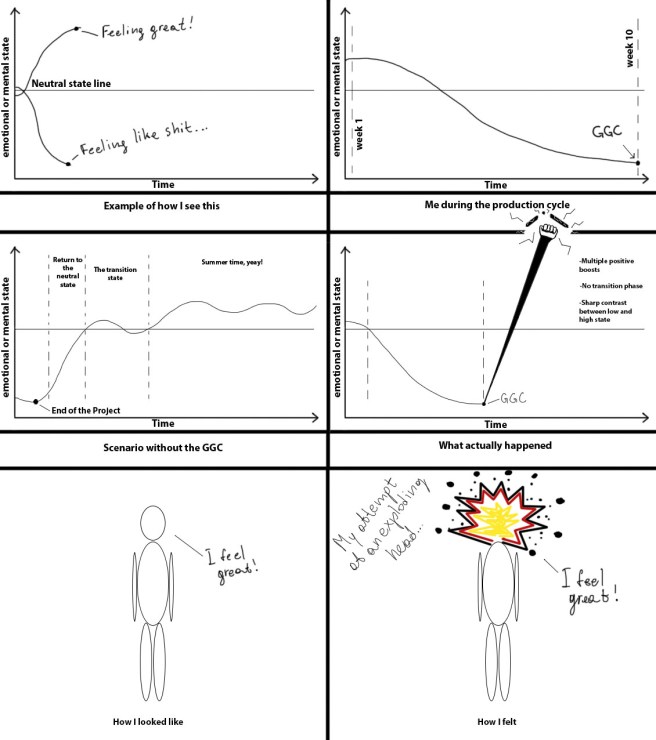
All of this together combined resulted in a feeling of exaltation that lasted at least for a week. But I also think that all this can be illustrated for a better understanding.

This is based on my theory about team harmony/disharmony but on a scale of a single person. And I am not a phycologist, so don’t take this too seriously.

GGC feels in pictures

If my unhappiness was based on the group work than it is possible to assume that once the group work end I would have eventually gotten back to my normal mental state, maybe fast or maybe slow. But the point of the release itself was the GGC where I was able to safely say ‘I am done with this project’. But instead of just recovering my balance I got a boost of several positive influences. This resulted in a sharp difference between feeling awful one day and feeling extremely happy the next day. It is this contrast, without a slow transition, that exploded my head.

I would keep telling my roommate how happy I was for several days and when I described this to a Liberal Arts student he said, ‘It sounds like you found God’. I am not a religious person but I thought that it sounded very poetic. And how cool is it to tell people ‘Why am I in the game industry? Oh, no big deal. I just found God there.’

And that is how I ended my first year as a game designer and why I wrote all of these blog posts. It was the contrast of having no ideas for weeks and then having my mind flooded with ideas and thoughts 😀

Thanks for reading!


1-year milestone. Part 3.5: My beef with artists/coders/producers

This is the second to last thing I want to write about. All the complaints I can think of about the other team members and their line of work.

My “head count” so far:

A luxurious number of artists: 5 different artists with their skills ranging from high to low.

2 Programmers who both were brilliant.

2 producers who together can be considered as much as 0,8 producers. It’s was a complicated situation. One of the producers hated this line of work, we were informed of that and didn’t consider him a producer but rather an extra member of the team. The other producer dropped half way through the project.

A good design is a design you don’t notice. Same thing goes to this blog post. I only write about stuff that disrupts the process of work. And from my “stats” it is not a surprise that I have most to say about the artists. But I will be fair and try to mention as much as I can about programmers and producers.

Also, since I am a designer, I can’t really write much about designers. I have already discussed extensively how I see this line of work. But if you have some tips and pointers about your beef with a designer – please share.


Artists:

Sketching, work in progress, sharing. I think I have mentioned these separately in other places and now I will mention these in the direct context of team members who don’t do this properly. If you, artsy people, don’t do these 3 things thoroughly it will result in one thing only – the designer saying, “This is a great picture, but it’s not what we need”. The designer feels like crap for dismissing your work, you feel like crap for having your work dismissed. Everyone feels like crap. It doesn’t have to be this way.

  • Learn to sketch: When you are told to draw something, you need to not present a single picture (unless there is ABSOLUTELY no room for a misinterpretation) but a series of simple drawings. The point is to experiment with the idea and the picture. If you are asked to draw a frog – make three or five or ten sketches of different frogs.
  • Learn to show your work in progress: Once a sketch is chosen, you can start coloring and filling in the details. If you worked on something for several hours, I assume there will be more than just a sketch by that point. And as a designer, I want to see which direction your progress is going so I can intercept you in case you strayed too far from the course. To prevent this, I NEED to see what you are doing. This isn’t just for me to complain. I might have miscommunicated something or didn’t give detailed enough description, or left some area of the idea blank and need to go back to specify it. Seeing your work in progress is as much important for the designer as it is for the artist. This isn’t a freaking competition, we work together. And this will prevent the need to send you back to your tablet when you bring me something finished that is not what I asked you to draw.
  • Learn to share: I personally would love to see everything in our shared folder! Any sketches, any progress on the picture at the end of the day. But what I, sure as hell, want to see in there are the finished pieces. Jesus Christ, how hard is it to upload you finished work? Must I ask 3 times to do this? If you are suddenly hit by a car while caring your laptop with all your work and the laptop is destroyed – all your work is gone. We can find another artist, but it would have been great to not get thrown back to square one because someone was sloppy at uploading. Sorry for sounding cynical, but that is the truth of it. You need to make sure your work is shared and saved somewhere where other can have access to it in case something happens to you. Preferably .PSD thx!

Some people are shy and unsure about their work (see Imposter syndrome) but you need to find a way around this. These three things aren’t just a matter of the workflow. They also show that you as an artist is working and contributing. If you hide your work from me, I will assume that you are slacking. This doesn’t apply to just artists, but also coders/designers/producers.


Polish that never happened. I have heard a lot of times us say “it’s good, we will also polish it in the end” and then that polish never took place. You are, obviously, not required to give us assets that are 100% finished. But you must be aware of the things that need to be done later when all the visual assets are brought together. This is something a producer should keep track of, but also you yourself. If only 1-2 weeks are left, you must go back to your assets and inspect them and make finishing touches. Preferably something that is detectable by us, simple mortals, otherwise one can again assume that you are slacking.


Criticism towards the art or criticism towards the design? It is true that artists are the highest authority in the questions of Art. However, an artist needs to realize that someone else who isn’t an artist could give a legit critic about the artistic side of the artifact. In other words, someone who isn’t primarily an artist may have some knowledge about the technics and the theories that are within the domain of Art. Another thing to consider is when the critic is directed not towards the art side of the picture, but towards the design. And if this critic comes from, let’s say a designer, then you, an artist, are no longer in the position of power. No matter how good you have drawn that horse of yours, if a designer asked you for an elephant, you have clearly missed something.

While we are on the subject of deeming someone’s art, you know what else? I don’t give a flying fuck about how many people in what high places deemed that horse of yours as brilliant. Did those people examine your horse as an isolated piece? Or did they examine it as a part of a chain of assets? Did they read our concept document or talk to the designer about the vision of the game? If someone said that this horse is a pinnacle of the artistic expression – put it into your portfolio and go draw my damn elephant. While artists can judge the craftsmanship of the picture, I can judge whether you follow my design or not. And since I know my design best because it is MY design, opinions of all the experts in the world are secondary. But I am always open for a discussion, of course.


Unconscious design. When an artist shows me a picture or a sketch of something that looks strange or intriguing but not as I imagined, I will ask them as to why this picture looks the way it does. And you know what a good artisan shouldn’t answer? “Because it looks cool”. To me, such an answer is the demonstration of the fact that the person wasn’t actually thinking about what they were doing. Perhaps there was some reason to it, but the artists didn’t bother to formulate it and understand it. I want to hear your reasoning, your thought. Perhaps there is something in this that escaped my understanding. Share your feeling, sell me your vision. But if you don’t even know why you are doing things, there is a little chance that I will know why you are doing those things. Any explanation that connects the picture to our concept or to the other existing elements is better than hearing “Because it looks cool”. And this might work if you give the designer a dozen of pictures/sketches. Then the designer can look through them and choose something that is closest to his vision, cool or not. But if you only deliver one image and even that you can’t motivate, you have clearly been slacking.


Programmers:

Unconscious design, only worse! While an artist must interpret and understand what a designer wants, a programmer deal inside a very strict frame. It is much easier to draw a diagram for a programmer to work with, rather than to draw a sketch for an artist. Remember that you are finding a code solution to a specific problem. To get from a programmer some mechanic that wasn’t intended because the programmer thought it is cool is ten times worse than an inability from of an artist to motivate their creating. Something that an artist thought was cool could be erased in a matter of seconds and doesn’t influence the product yet. Something that a programmer thought was cool sends a cascading wave when the new mechanic interacts with EVERYTHING in the concept, dynamics, aesthetics. The problem usually is that none of this was accounted for by the designer so the results could be disastrous. For this reason, if you come up with something that you think is cool, first tell about it the designer. Perhaps make a separate prototype file where you show this mechanic so that the designer could inspect it without worrying about the whole game client collapsing. And the same thing applies, as with the artists, motivate why you think it is a good idea. Don’t say you find it to be cool…


Ask for help. As a programmer student, no one expects you to know the most optimal solutions to your problems and the code you are asked to create. It’s ok to not know how something can be made to work. Ask your fellow students and teachers for their opinions and advice once you are stuck. DON’T go for a week trying to find a solution on your own. Spend a reasonable time on thinking on your own and perhaps searching the internets, then turn to others for help. I’m sure the teachers can help with most of the things you could possibly have trouble with. Also, if you can’t understand something that the designer asks you to code, ask the designer to show an example in another game or to make a paper prototype.


Producers:

I tried to think of something to write here, but there is nothing. I had no experience of a real administrator watching over my shoulder the whole project so I can’t really say anything. Except that I know for a fact how much easier it is when there is someone dealing with all the routine like schedule, a place to work, keeping track of progress, deadlines, individual effort etc. I know that the first year the Project Management program run was not a smooth ride, but this goes to all of us being the first people who got the taste of the 4 courses. I hope that the feedback GAME got was sufficient enough to make adjustments.

If you have something you can say about the producers, please do. But don’t rant about producers who were clearly not doing what they were supposed to do in their role as a producer. I would rather like to hear about a producer who gets the job done, but could do it better and interfere with the workflow less. Warning flags of a disruptive behavior and such.
1-year milestone. Part 3.4 How I thought MDA was useless to me.

MDA stands for Mechanics-Dynamic-Aesthetics. You can read a short paper that introduced MDA as a framework term here: http://www.cs.northwestern.edu/~hunicke/pubs/MDA.pdf.

It has been a year since I was first shown this picture and told about MDA.

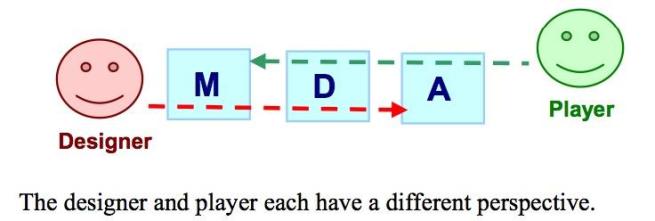
MDA structure

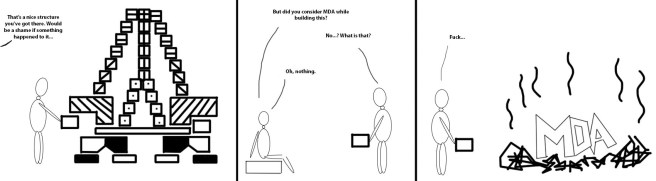
And only during my summer of the reflecting bonanza have I started to come to some terms with it. Still, I have my own interpretation of MDA. And I can say that during the year of development I have never thought of MDA actively while developing. Whenever I was faced with the requirement to discuss MDA in my final reports after any project I felt like this:

MDA frustration

What was the issue to me? As of right now, I have two ways to see MDA. In a way, I believe that this confusion is caused, yet again, by the fact that this is a practical rather than theoretical education. Understanding of MDA requires a philosophical discussion which is mostly skipped here in the favor of making games. So, it took me a year to waddle over to this point and I am supposed to be a more theoretically inclined member of the team (as I claimed in part 3.1 and 3.2 about who the Game Designers are)! This leaves me to wonder how much understanding did those of us get who spend their time in lectures about practical skills only, like drawing and coding and managing? At least the Game Designers had some time to discuss this in our smaller class.

My first interpretation was based on the picture that is taken from the original MDA paper and was showed in our faces several times (top picture in this post).

Examining it without an extensive discussion left my understanding of MDA impaired. I could only see it as an isolated system that exists by itself. A system that can be summarized like this:

  1. Create something that is something or does something.
  2. Create a series of somethings that interact with each other in some discernible pattern.
  3. Feed the pattern into the mind of a player via sensory inputs.

If this is a player’s perspective, it’s going to be turned around obviously. The player will consume the pattern, break it into its elements and digest it.

Kind of a crude way to describe the process of creating a game, won’t you agree? For that reason, I was mostly in denial about using such a system when crafting games. It would confuse and infuriate me when a hand-in required us to mention how we considered MDA in our work process.

But now I can see that I considered MDA after all. I didn’t call it MDA, and I still wouldn’t call it this way. The truth is that the original paper tries to reference this in a very… clumsy way, in my opinion. I’d say that to the authors it was more important to create a point of common reference for the scholars and developers. So, it’s not strange that a student glancing over the paper about the MDA framework would pay more attention to the visual presentation of MDA rather than the actual message. Especially so, when that image itself is being shown to us in the lectures. Please, understand that this is my way to see things.

What do I mean now by saying MDA now? To me, it is a core of the creative process. The three main spheres of any game. But it isn’t about a straight line. Rather, it is about the understanding of the how elements influence each other. The understanding that anything you add to the game influences your product in all direction. One must think forward and backward at the same time. One must remember all the crafted assets, all the planned assets and all the assets that might be considered in the future. And one must see the ripples that are sent through the dimensions of the mechanics, the dynamics and the aesthetics by any discussed idea. A synergy of the highest order.

So, was I considering MDA when I was working on my projects? Yes, if the complexity I just described is the MDA. Otherwise, I considered something that is much bigger than a picture with three words and 2 arrows.

1-year milestone. Part 3.3: my two cents on the topic of design.

In part 3.2 I tried to explain the role the game designer. But it is also true that while some of us are always game designers, while some of us are occasionally game designers, all of us are just designers at all times (in game development). If the sense of design is just the ability to recognize and create a pattern (my interpretation) then this is a common human trait and even more so in people who are artists. By the way, all of you in the game industry, you are artists. Face it. How does that work then?

Imagine the world like DnD where magic is a common occurrence. And let’s take the population and split it into groups of different level of magic usage. Naturally, there will be those are talented at magic and spend their lives dedicated to just magic. They will reach the heights of level 7-10 spells in their life. These would be our real-life game designers – people who keep track of hundreds of patterns in their head at once. Then we have the people who are proficient at magic but deal with other things rather than just magic. They will reach in their life spells of level 3-6. These I will consider designers, people who are confident when they need to deal with individual patterns. But because they focus a lot of their time in other areas of life, they can only occasionally compete with the level of game designers. Then we have the general population, people who can probably master spells of level 1-2. This is our universal ability for pattern recognition. The majority has it, it’s only a question of how far people want to take this. Should they choose to become designers or even game designers, they will have little issue in this. And then we have a type of people who have no affinity to magic (barbarians and fighters, I guess?). They don’t have the affinity for magic and that’s the end of it. No matter how hard they wave those wands and how loud they read out those scrolls, nothing will come of it. Same thing in real life – there are those, who simply have no sense of patterns. It’s not a crime, it just the way it is. These individuals most likely have some other sort of expertise.

What do you do with those are bad at design then? To be honest, I don’t know. I feel that people within game development and artists, in general, are the ones who have a high sense of design. If the sense of design is not there, I am not sure if they can be a part of this branch at all… Perhaps if a coder or an artist can follow instructions to the letter they will create just what you ask of them? But if left with creative freedom they won’t be able to deliver much, since the ability to generate patterns is not there. I am not sure at this point what to say about the subject of bad designers…

And so, when I speak of design now, I mean the general ability to recognize and create patterns. And in game development, most of us are proficient at this, while game designers are supposed to be experts. Also note, that an expert could mean not the ability to create an exquisite pattern, but the ability to identify any given pattern in a minimum amount of time, the ability to retain information of hundreds of patterns and the ability to interconnect a large number of patterns.  Okay, now that I have explained what this is about, here are some of my observations that are about the design in general.


Start exposing yourself to new ideas if you want to become a better designer. They have told us this in our class so I’m simply repeating here. Watch movie genres you don’t like, force yourself to play games you would usually not play, go to a museum you would not step into before, attend talks about subjects that you don’t understand or aren’t interested in, visit antiquity and curiosity shops, read books. Approach these from a perspective of someone who is generally interested in how they work. Make this about the structure rather than the message (the message is also important though). You might find that suddenly everything is interesting to you. All this knowledge will make you a better designer. I can say that this summer I’m super hyped to go to the Museum of Modern Art and I loathe that place…


Deconstruction of a concept as a solution to a bad design. This is partly a copy of something I wrote in part 1.2 where I was discussing ideas and how to handle them. Since this has also to do with the design, I will partly repeat it. There are no bad ideas, rather there are bad deliveries. But it should not be hard for a good game designer to pick apart a concept document since a good game designer will be able to identify a base pattern or a foundation for a pattern in any type of mess. Even 5 pages of text that are boiled down to a single word, is still something that a good game designer should be able to accomplish without too much effort.


A show of small potential for a great design goes long way too. Another something I talked about back in 1.2. Some people are not good at articulating their ideas and designs. Other ideas seem like silly bullshit. But even the worst of these can be iterated by talented people into something amazing. A tweak to the design here, a clarification there and voila! Which leaves the question: was the original idea or design bad then? Perhaps it was simply not communicated well by the original creator. Part of being a great designer, in general, is to identify these patterns or holes in the patterns that can be filled.


Liberal arts or the conversion of heretics to the true faith. After I wrote this line of thoughts to myself something curious occurred. Ernest Adams, one of our teachers in this education, who also happened to hold the award ceremony’s opening speech at Gotland Game Conference 2017 made a comment about how GAME was settled with Liberal Arts by Uppsala University when GAME became the part of the university. And then Ernest chuckled to himself. But, I think that this might not a have been a coincidence. I had a pleasure of socializing with a bunch of “liberals” (that’s how I call Liberal Arts students) and most of them were gamers themselves who also showed a high level of comprehension of design in general. Perhaps it is because Liberal Arts expose the minds to an influx of different ideas and phenomena. At first inspection, Liberal Arts to me seemed a complete chaos. But what if the base of it is just a high variety of different patterns in different contexts? You should also look up what people study in Liberal Arts because I personally had no idea until I happened to become a roommate with a student from that education. By the end of the year, I successfully swayed that person to join the Game Design education, ha! So, if you are thinking about what to study to fill in those free academic credits then Liberal Arts is a safe bet!

Extra Credits also has an episode (man, those guys are so spot on!) where they support this opinion. They generally talk about what makes a good game designer. I guess I could have already linked this video in part 3.2 but that part of my blog was directed at explaining who game designers are to other members of a development team, rather than giving a general explanation of who they are. Anyway, this episode is also great at explaining who game designers are supposed to be:

https://www.youtube.com/watch?v=kNscZCrke4k


The ability to interpret and compare designs. Comparing two good designs is like comparing apples to pears. They are simply two different items that have no proper way to be compared to one another because good or bad is subjective. But what you can do is run both designs through a list of requirements and see which of them succeeds more at delivering certain criteria. Check each of designs for properties they possess and choose the ones that are needed for the assignment. Establish what is it you are going for and which design delivers more points instead of asking which design is better.

In my first project, I had a case situation which is a great example of this. The artists got an assignment in their class to create a GUI menu for the game they were producing. And here is the picture of the two results we got (both of these never made it into the game, unfortunately):

tree_comparing

Now, I don’t know what exactly the assignment was but I do remember that (in the words of the artists) the teacher preferred left design. Now, what the teacher opinion was is beside the point here. And remember that I had no pre-requisite at all for this delivery. When I, as the game designer was presented with this, I deemed them both excellent. But excellent in different ways.

The left one to me was: traditional, professional, on point. The left one was: individual, quirky, but also something which at that moment in time I called “accidentally great design”. Look at how the tree, which has been made earlier without any consideration of GUI became the perfect nesting place for the button. Note how the buttons involving the game are clustered on one side, while the Exit button is off to the side? This way you can hopefully see that both of these GUI are great in their own way. Since we couldn’t decide on which one to use I asked a guild of mine to help. And, (surprise-surprise!) people split almost in half between those who preferred the clean design and those who liked the quirky design. Which proves my point of how it is hard to claim something is better than another thing. People just have different perceptions. What you can claim is that something delivers better for the given task. A good designer needs to understand that we are looking for specific criteria in the design. And if you end up in a situation of a tie, then you should trust your gut feeling. But remember to explain your opinion to your team and the people whose design isn’t going to be picked to avoid any hurt feelings.

1-year milestone. Part 3.2: But aren’t we all game designers? Yes and no, most of the time – no.

Here it comes, the most interesting part of my monologue. The question of who are the game designers to me and why most of us, students, aren’t game designers when we are working in a group. As I have already pointed out, game designers as a title were avoided like the plague in the descriptions of the courses. Furthermore, all branches are called Game Design. Yet the role of a game designer is a specific role in the group.

So, are some of us more game designers than others? I think the best answer is this: all who create a game are occasionally game designers, for a brief moment or an extended period of time. Certainly not all the time. But we, who are titled “game designers” are inside of this domain all the time. And just like you can visit our domain, we can visit your domains of code/art for some time. But do we claim to be artists or programmers because of our brief moments of insight? Certainly not. So why would you claim to be game designers? Doesn’t sound fair to me. (I avoid producers in this because their line of work has to do with the workflow rather than the direct process of creating things. But even they can be visitors in our fields of expertise, as can we be in theirs.)

-Oh, ok, fine, I guess. So, what is your job then, mister game designer?

Well, let’s see the cursed description on the official university page (picture in Part 3.1). Prototyping, documenting, communicating, narrative, game system and game analysis… Doesn’t sound very clear to me, personally, though it is an accurate description of our individual tasks. The issue here is that these are the descriptions of the individual skills taught in the courses. Like saying that an artist’s job is to hold a brush. It is not an actual description of who a game designer is.


Now ask yourself if you know who is an architect? That’s an easy question, isn’t it? It’s that person who DESIGNS the building. He doesn’t build it himself, he only provides the blueprint with the instruction of everything that is the part of the building because he must consider all these factors while DESIGNING.

Do you know who a musical conductor is? That person waving a wand at the concert you say? Well, that too, but here is a quote from Wiki: “The primary duties of the conductor are to INTERPRET the score created by a composer in a manner which is reflective of those specific indications within that score, SET the tempo, ENSURE correct entries by various members of the ensemble, and to “SHAPE” the phrasing where appropriate.” When you get to a concert hall, you don’t really see the actual role of a conductor, because by the time of the concert his job is finished. The conductor has finished shaping the musical creation with the instrument that is his orchestra.

Do you know (I promise this is the last one) who a choreographer is? Here is another Wiki quote: “Choreography is the art or practice of DESIGNING SEQUENCES of movements of physical bodies (or their depictions) in which motion, form, or both are specified. The dancers are simply the tool for realising the vision of the choreographer.

What is common between a choreographer, a conductor, an architect and a game designer? These people are on the outside, in a manner of speaking. They see the bigger picture through the ability to zoom out so far where they can take in all the details and patterns. And this is what designing is to me – a process of creating a pattern. And while an artist, a programmer and a producer are all designers in a way they create patterns through the visuals, code and human behaviour, there are those who take into consideration ALL of these patterns. At least, they have to, or they can’t truly be good game designers. A real game designer is someone who must scope out far and wide in the search of good patterns and then weave these patterns into a more complex pattern of their own. There you have it, who are game designers are to me and why I love the word “pattern”.

So, no. We are not all game designers in a way that we are not all the weavers of the patterns on the biggest scale in this line of work. But we can all claim to have the knowledge of game design, as we know in a way what this is. Just as a game designer may have knowledge of art without claiming to be an artist. And I guess we are all studying Game Design after all, if you look at it from that perspective, but some more than others.

This also brings me back to my original complaint about the titles of this education. While I can see now that there is a legit reason to call everything Game Design, I now wish even more to call this education Game Development. The reason being that we don’t deal on a big enough scale with the philosophical side of the question “What is Game Design?” to reach the understanding of how complex this topic is. Instead, we make games. And making games teaches us the development and production process. While it is undeniably a part of Game Design, we don’t truly delve into the depth of this topic. Just as while studying Russian I get some understanding of how linguistics function, there are those who study just linguistics. And linguists deal with the systems rather than going into a detailed use of a specific language. This is also why a non-gamer will have an easy time drowning in this education, because the philosophical question of the systems, the need for the exposure to the systems, in general, is skipped here. We are already expected to know games. Same way as a linguist might have an easy time understanding how any language functions because they have studied systems as big scaled patterns rather than a study of an individual pattern of the systems.


And that’s the end of my rant about game designers! Hope this makes some sense, otherwise, I am sorry! =D This is a complex topic, so no surprise if this might look confusing. In my next part, I will take up some individual examples of me dealing with design. And after that, I will make a part of all the issues I had while dealing with artists/coders/producers interfering with my designs. And the grand finale would my reason for all this nonsense, that should also be fun!

1-year milestone. Part 3.1: Why did game designers get robbed of their title?

1-milestone. Part 3.1: Why were the game designers robbed of their title?

Finally, the part of this blog that I looked forward to most. And while I thought to start this part of discussing the game designers a bit differently, the fates decided otherwise.  Someone might have mentioned this in our designer class discussions, but I have no memory of this. Perhaps I will make a fool out of myself, but I feel that this is an important observation which needs to be made before the start of the discussion of “Who are the game designers?”

I have a vivid memory of sitting at the first lesson of my program, which was Bachelor in Game Design. And the teacher (Hi, Adam!) asked us for the reason as to why we were there. And I remember that I said that I didn’t know the exact reason. That I had little idea as to what I was getting into. What I knew at that moment was that I wanted to study game design. I wasn’t even sure what game design meant, only that it had something to do with the games. And I wasn’t a programmer or an artist, for sure. I was reluctant to take up the burden of managing people. And there was the 4th option, which was something called just Game Design, so I took it. I took it without knowing what it actually was in reality. Do I know what that means now? Yes. Did my teacher know who we were supposed to be? I believe so. Even our substitute teacher who had workshops with us occasionally seemed to know what we were.

So, why didn’t I know back then? It is unlikely to think that I could have misinterpreted the descriptions of the course. Not after dealing with these types of text for 4-5 years at Stockholm University. Ignoring the usual academic mumbo-jumbo, there is, in fact, a glaring issue in the pattern of the course descriptions. It is obvious that those who came into Bachelor in Game Design PERIOD were supposed to fill in a role in the production groups. A title. The role and the title of the game designer. And yet, nowhere does it explicitly state who we supposed to be…

course desription

Suffice to say that the Swedish version is the same.

Ok, let’s see where to begin untangling this mess… The course description never actually calls us for what we are – game designers. Could it be that by calling one branch “game designers” it breaks the main title of the three other branches? Yet this was what caused the confusion in the first place among the students: Why are those guys studying more game design? Aren’t we all game designers?

One could parry the absence of the word “specialises” in the short description in two ways:

You could claim that we need to get the speciality through our free courses. But this is bullshit. I intend to spend my points from languages as my free courses. This won’t make me into a specialist in languages, this will make me into a game designer with the sub-type of languages or whatever…?

So, perhaps this is because of those 6 different skills in the long description? I am sure that a coder/artist/manager can name up to 6 separate skills that are taught in their line of work, but you don’t see them getting robbed of their titles.

So, could this be that we are just victims of the academic rhetoric in the description of the courses? I know how idiotic it could get sometimes, but this is just too much. If this is the case then I will get seriously upset…

So, only after a year of studies can I conclude that I am a game designer in my title. And a lot of us, who were working on the games were in fact NOT game designers, but something else. Let’s delve into why an artist, a programmer and most certainly a producer aren’t game designers. Well, mostly not game designers.

1-year milestone. Part 2.5: After the project ends.

This is a small post with only a couple of thoughts that I had a hard time placing anywhere else specifically. I decided to just make a separate post for them because I associate them with the end of a production cycle. If there are things that you get to experience or notice when you ended a project, then please share!


Over-burn and the price you pay. There are many talented individuals who do other things besides studying game development. And we all have a life outside of our studies. The trick is to find your balance. If you juggle several cross-disciplinary projects then you risk going into an over-burn mode and this has a high chance of ending badly for both the individuals in question and those around them. Take one or two things at a time, because if you have too many balls in the air, if one of them explodes in your face, then this may cause a chain reaction that could potentially cause harm to both mental and physical health. It is painful to see someone talented leave because their body gives up from the overload of things. You want to feel well to make your games, don’t you?


Feeling ashamed of your game. Argh, this one is painful… Remember, that we are all student here and this is an education. This is the time to fail. It’s ok to feel dissatisfied with the results you have delivered. It is not ok to feel ashamed. If you are ashamed of your game, this is most likely an evidence of something being wrong within your group (the disharmony). Talk to your group about your dissatisfaction, map the weak points of delivery with the team members and move on to the next project. You still managed to create something in a short period of time. Some companies (not mentioning any names…) managed to deliver bigger turds while having huge budgets and bigger time frames. You are definitely not the worst in the world and not even the lowest tier.

And if you feel like telling people about your feeling, just be mindful of the environment where you share your low opinion of your creation. Someone who is playing your game or is about to play your game might overhear and that might damage their opinion.


Losing a member makes people sympathise with one’s group? Not sure why that is, but it seems that people sympathise highly with team members who have taken losses. Could this be connected to the value of the game rising in their eyes as they re-evaluate and redistribute the load of disciplines in their mind? So, if you want people to make an accurate judgement of the game you made, don’t be embraced to tell that this isn’t a work of X people, but of X minus X.

1-year milestone. Part 2.4 Imposter syndrome or an imposter?

You probably have heard of a saying “Fake it till you make it”. This saying is about something called Imposter Syndrome.

Here is a wiki link for a quick reference: https://en.wikipedia.org/wiki/Impostor_syndrome

I also remember this expression sticking with me after a certain TED talk, so go check it out too, if you haven’t seen it:

https://www.ted.com/talks/amy_cuddy_your_body_language_shapes_who_you_are

If you are too lazy to deal with any of this, then here is the bottom line – when you deliver what is expected of you, yet you consider yourself to be an imposter or someone who gets things done via dumb luck or other circumstantial reasons, rather than skill.

As a body of students, we are thrown into the development of games in our first year. It would silly not think that a lot of people here are facing Imposter Syndrome. Hell, I myself only recently started to feel like not a complete designer imposter. I know that I have given miniature lectures to groups of 30 people for 5 terms at Stockholm University, yet I never considered myself to be a proficient instructor. While legit and experienced university lecturers told me that I was great – I still doubted it.

The differentiating between the people who feel like a fraud and the actual frauds is crucial here. Otherwise, this can result in a witch hunt and the Spanish Inquisition. What am I talking about? I am talking not about those people who doubt their skills, but those who lack most of the vital skills to be game developers and/or an expert in their field of speciality. To put it roughly – if you have no hands, then the chances of you becoming a piano player are ever so slim.

Now, before I cross the line of no return, yes, some people might try to develop the needed skills and be open about their efforts. Again, these aren’t the people in question, as there are strong and weak players on this journey. If all the cards are on the table, it is a fair game.

However, imagine the situation where you have a certain confidence that the person has some skills (which is a naïve point of view, that I have now erased from my mind completely). And this person appears to deliver things, yet the quality isn’t as good as you thought it should be. Now, subterfuge is a part of the “Fake it till you make it” and if someone manages to fake it all the way to success, then kudos to them. But if a fake can be identified in the work process (through unexpectedly low quality, empty promises, etc.) then this person should be expelled from the group without any further discussion. When they are revealed as a fraud, they have violated the trust that was put into them. In the environment of tight schedules and constant deadlines, these people are leeching off the effort of others. It’s no wonder that unfortunate team members feel like working for two and not moving forward. The reason for that is the fact that the effort of the team is being calculated for an X amount of people, while the equation should be X-1. If you were a shop, you would have been taking losses in your finances without a good explanation.

I am a firm believer that all of us (MOST for sure) have some sort of value inside. But the transparency and the mutual understanding of a thing like a low personal skill are a requirement for this to work. If you are pretending to be something that you are most certainly aren’t, then don’t be surprised when the banhammer smashes your face.

So, is there no redemption? Is this bloodlust unnecessary? Aren’t we all here to learn?

A teacher gets paid to teach us, the outcome is secondary to this. I know that if I were to get paid, my patience would increase until almost infinity because such is the nature of the contract. But as a student, I am not bound to teach someone. I can help, but I will not subject myself to working as a teacher while I’m also making a game. My contract with my team members is to do my work and be open about it. If I’m being crippled by someone riding on my back with an argument that we are supposed to teach each other, I will get mad. If my trust and my contract are violated, there will be righteous smiting at hand. But such is my personality. Others may choose to simply move on and that is fine too. And yes, we are here to learn. Both parties will get a unique lesson to learn from this. While you, my reader, might have never experienced this, trust me in this: identifying and unmasking an imposter will bring some strong emotions and most likely strong desire for justice.

So, in the conclusion, now that my angry rant is over, please remember that this is about the identification of true imposters. While we suffer little in the study projects, people like that are a mortal danger for a real workplace. Mostly, they are great at causing an obscure dissonance that I explained in part 2.2.

1-year milestone. Part 2.3: Causes of the group disharmony.

So, what is the point of this section? I know that the motto of our education is “Fail fast and fail a lot”. But I personally prefer fair warnings about where I might fail so that may I pay attention to these queues, rather than stumble blindly around in the darkness. A lot of these things, if not all, can be predicted and foreseen. So instead of failing at the basic stuff, I would have preferred to avoid the potentially known obstacles and hit my face on something more interesting and unusual.

I also highly encourage people to share other patterns they’ve got to experience that are not mentioned here and together we might map out the dangers of this road together.


Slow withdrawal from the group. Losing a member is always a damage to the group’s morals. One must remember that the higher education in Sweden is free, so we aren’t forced to study (we being the Swedish citizens, but also EU citizens and Switzerland/Norway. ). So, we have a freedom to leave easier than someone who is paying for the education. Withdrawal can be caused by many different factors: real life problems; the realisation of not having an interest in the subject; the overall disappointment in the education; even a bad group can cause a person to quit, etc.

To those of you who are withdrawing – don’t be selfish jerks. If you are feeling like leaving the group and the education, then inform people of your decision. Don’t let people wonder where the hell is the girl/boy/Apache helicopter? Just tell people of your decision so that the group can adjust the allocation of the resources and consider the change in their working rhythm. Other team members might even be able to give you new perspectives that might reignite your desire to stay.

To those of you who are faced with someone’s withdrawal – get in touch, hear the person out, try to give your perspective and then let it happen whatever will happen.

Why am I bringing this up here? Because while many of the reasons for withdrawal are out of our control, one isn’t. That reason is a sense of strong disharmony in the group. The person might be sensing the symptoms of an unhealthy environment but chooses to flee instead of dealing with the problems. Not all of us are able to withstand for long obscured dissonance. But such people could help others to realise the subterfuge issue.


Shorter meetings. A red flag that appears usually when you are several weeks into the cycle. If people are hyped to meet up at first, but then start to leave from your workplace earlier and earlier, something might be wrong. Why don’t they want to stay? Does something make them feel uneasy or uncomfortable? I know that I felt like fleeing home after 4-5 weeks of production. I simply didn’t want to stay and work with people on the spot. This is something to stay on a lookout for the producers.


Inability to articulate/communicate as a giant red flag. Some of us aren’t good at speaking their mind, there is no shame in that. Let people try to explain what they are trying to say and be patient. But what if you are finding yourself confused time after time even after lead up questions? And is this the case for both written and verbal communication? Or several languages? And if you finally find yourself turning to someone else in the team and ask them “Do you understand any of this??” and they go “No.” then sound the alarm! Developing a game requires a level of high-quality communication. Someone who is not sufficient at this in all its forms becomes a giant obstacle in the way of the group.


Age of a team member as a point for consideration. Most of the student body that went to the 4 courses with me are young people, a lot of them are fresh out of high school (around age 20). These are usually people who might confuse their love for the games with the desire to make games, which I already brought up in 1.1.

Some are older. They, usually, have already tried things that they didn’t enjoy (around age 23-30). A lot of these people were faced with the fact they might have been in a wrong place, made a wrong choice and finally decided to embrace their love for the game as something that could potentially become their path. I’m one of these people. I knew that I loved games not as a simple pass time, but as a medium and as a creative line of work.

And then, there are few individuals who have already been around for a considerate time (age 30+). If these people have been gamers for a long time already, they are a boon. Their life experience in a combination with a long exposure to the medium turns them into a gold mine of different perspectives.

But an individual who decides to get into the game development at a considerate age without a proper exposure to the medium can be a curse. And the reason for this is that they have no game literacy and the game literacy is almost not taught here. Okay, it is unfair to say that it isn’t taught much, but I’m sure that most of us already come here when we are proficient at it. I mentioned this already in 1.1. You should also watch Extra Credits on the topic of gaming literacy: https://www.youtube.com/watch?v=8np2I_gQgcY&list=PLhyKYa0YJ_5BIUqSDPmfBuKjTN2QBv9wI

I am not denying these people their right to learn, but there is a considerate difference between learning game literacy and learning the development process. The second one requires the first one. So, a fair warning for the other team members is a must and a close monitoring of these individuals is necessary.


And this is all I have on the general danger factors… This section felt bigger but I kept moving things around into more digestible chunks. So I’ll do it this way – there is one specific topic I want to bring up that deserves a post in itself.  After that, I feel that this discussion should move on to the different specialities for when they are the source of the dissonance and the harm to the group environment. So, let’s first look at something that fits all profiles, which is a person that is a fraud, for the lack of a better word. And then I will move on to the dirty laundry of Artists, Coders, Producers, Designers respectively.