What are You?


What Am I?

I am You

You are I

I am One

One is two

two            is        many

                                                     many              is                      all

                                                all                               is                       nothing

                                      all                                 is                                       everything

                              all                                                    is                                   harmony

I am One

                   inside Two

                                         inside many

                                                                  inside all

locked in a pulsating dance of The Universe being

                               destroyed and reshaped

every Moment

forever and not at all.

                                                                           I am Harmony
I am One

a point in Time

and Space

                where Universe merges together into

                        a single Moment and where

  Two come together to exist

I am

One?

Yes

No

maybe

One is Two

dancer,

an infinite finite of Voices revealed and bathing

in Light

                                                                                                and

Dance,

a finite infinity hidden in Silence

in Darkness

          The two are forever bound together for neither can exist without the other

I s One

Two?

                                                            Yes

No

                                  Maybe

Two is Many

Like Dancer

and

Dance

merge to create One

so do Many merge to create

Two

                                                to become the connection between the

One

and

                                     The Universe

i is two

Many?

                                                       no

                               yes

                 Maybe

Many is All

every Body

and

no body

every One

and

no one

every Thing

and

no thing

every Where

and

no where

for Ever

and

n Ever

and every single

MOMENT


…is many

All?

Maybe

yes

Maybe

no

All is Nothing

A boundless emptiness forever consuming anything it touches.

     Darkness

                                                                                        that is forever alone in one place.

    Our Minds.


…is … all

Nothing?

MAYBE

All is Everything

Information forever trying to travel through

                                                               Darkness that separates everything

Filled with Light

that is always reaching out

                                                     to the others

                                                                              into the emptiness in the search of the limits

Our Bodies


…is all

everything?

MAY BE

Everything is Harmony

            An infinite Dance that contains ANYTHING and is ALWAYS and is NEVER and is NOW

…the Universe is a dance?

  Universe is Dance      dance is Harmony   Harmony is Universe

            DAnce is UniWerse              Universe is HarMOny           Harmony is Dance

       Dens is Dens                              Harmony is Harmony                     UniveRSe is Univers


…so, Everything is Universe and Everything is Dance and is Harmony?

Everything is Universe and Everything is Dance and is Harmony

Nothing is Universe

Nothing is Dance

and is Harmony

Many is universe

is dance

is Harmony

Two

is dance

is harmony

                                        One

is harmony

I

am harmony


i am


may

i

just

be


                                                                                an echo of the

          dancing

UNIVERSE    

 laughing...?


Ps. and the music is a part of this…

Visby January 21, 2018. Rest in pIEces my Ego.


Что я?


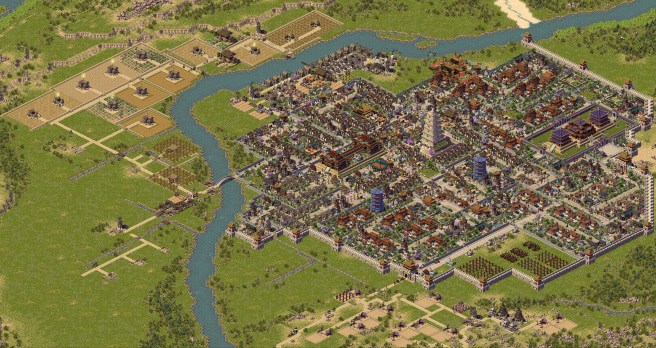
Bird’s view of China and Egypt

Update: You can now click the images to inspect them for more details.

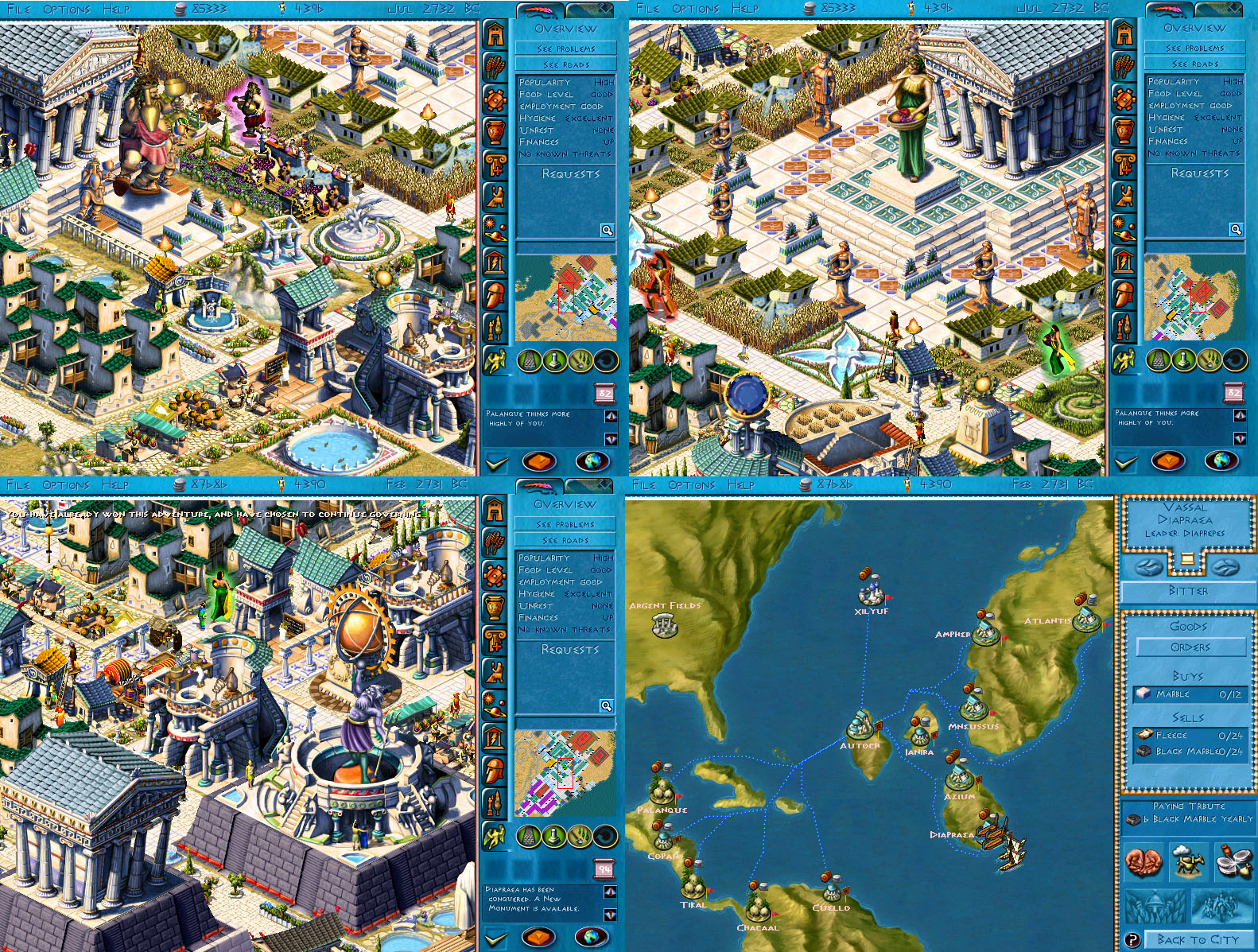
I got too invested in my Emperor city and decided to make a picture of the whole thing. It turned out great. And in theory, if you can figure out how to zoom in dramatically you should see the streets in details. Enjoy!

bird's view china

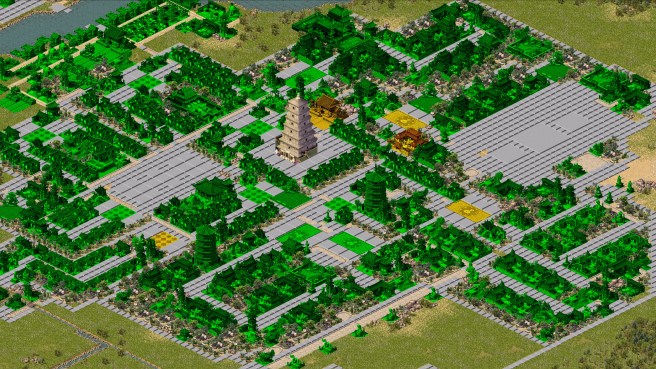
A humblebrag about the level of harmony in my city.

bird's view feng shui china

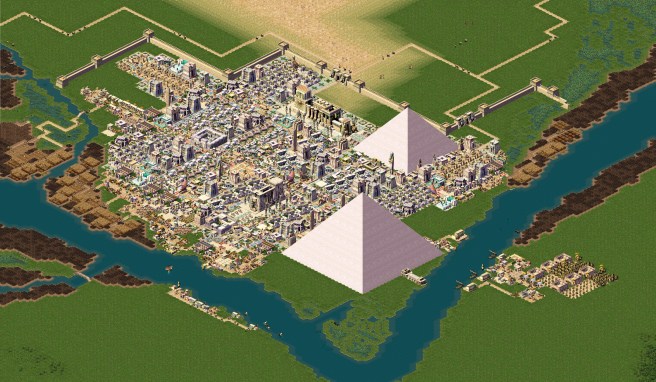
Also, Egypt!

bird's view egypt

And in the short future – Greece!

City builders: Emperor

Note: To see the screenshots properly you have to enlarge the whole page. Free WordPress doesn’t allow enlarging images separately, unfortunately.

Emperor: Rise of the Middle Kingdom (2002) is the last game in the city building series made by Impressions Games and BreakAway Games (Apparently BreakAway Games were also involved in developing the addon Cleopatra: Queen of the Nile for the game Pharaoh), and published by Sierra Entertainment. Emperor lets us build cities in the setting of Ancient China.

china4

A fair criticism of this game would be to say that there is barely anything new in this game if you compare it to other games in the series, excluding aesthetics. If we are to consider the series as an accumulation of mechanics that keep getting reshuffled every game, then Emperor brings to the table exactly 2 new things. Okay, let’s be generous and say 2,5.

As the continuation of my previous post about Pharaoh let’s first examine the main core of the game: satisfying the needs of the population. And I’m happy to tell that Emperor might be the game where some sort of balance is found in the department of people’s needs.

stats_ all ancient civs

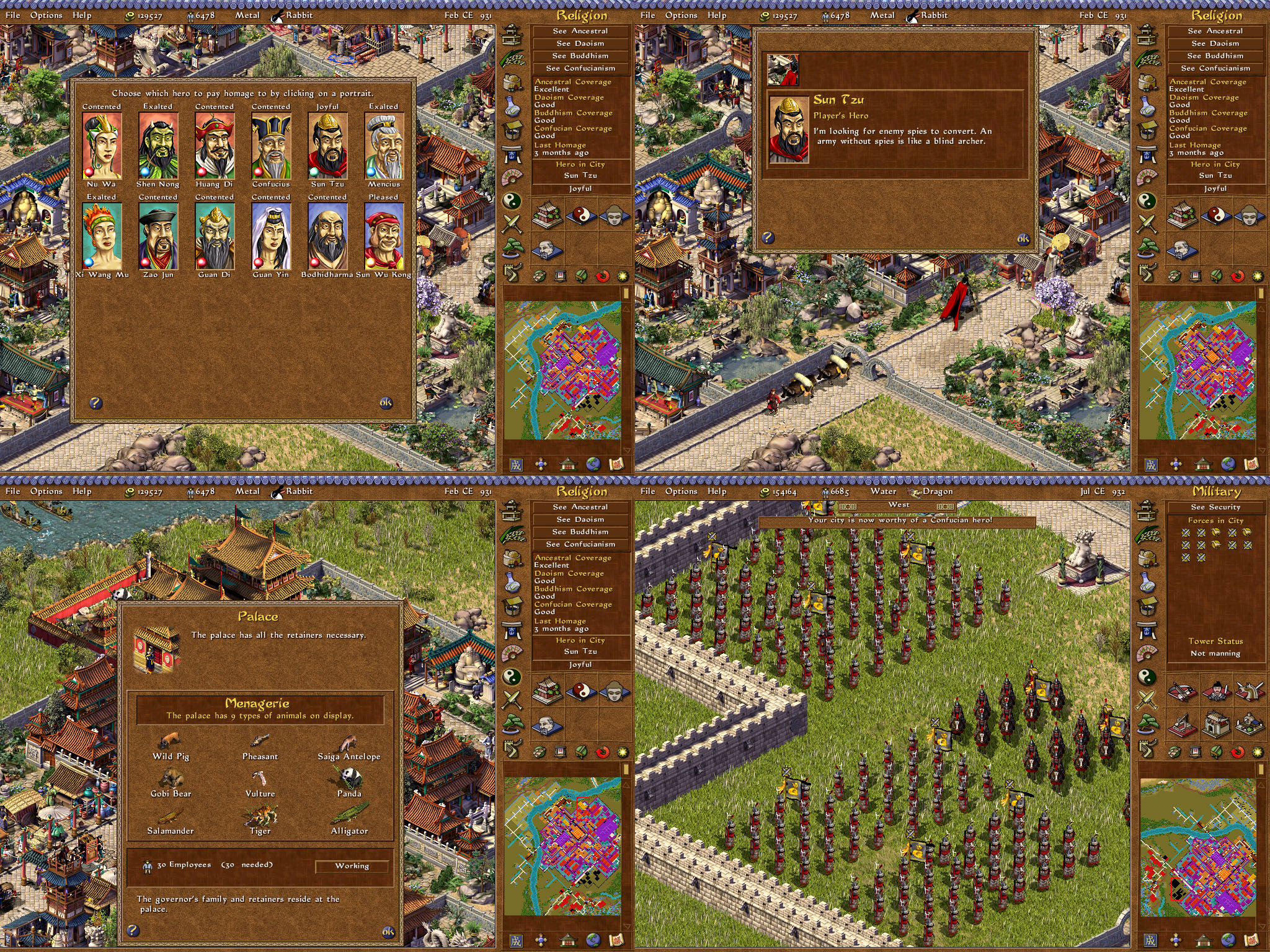
So, what’s new is in the game? Let’s start with the 0,5 “innovation”: interactive deities. That’s right folks! If ever you wanted to boss around a divine being – now is your chance. So what does that mean? It means that the gods we had in Zeus are back and now are intractable and can follow your command, rather than being random walkers. And this now makes exactly 2 entities that this game lets you control directly (the other one being your army units). The real impact of you being able to control gods is one: controlled blessings where before you had to hope that a god passes by a blessable building. Now you just tell them to go and bless the damned things. Get it? Blessing the damned, hurhurhur… Also, the gods can participate in the war, give certain economic bonuses, function as particular walkers and catch animals. Speaking of the animals, this is a new thing in the game, but it has no real impact on the game, so it’s the part of 0,5.

china1

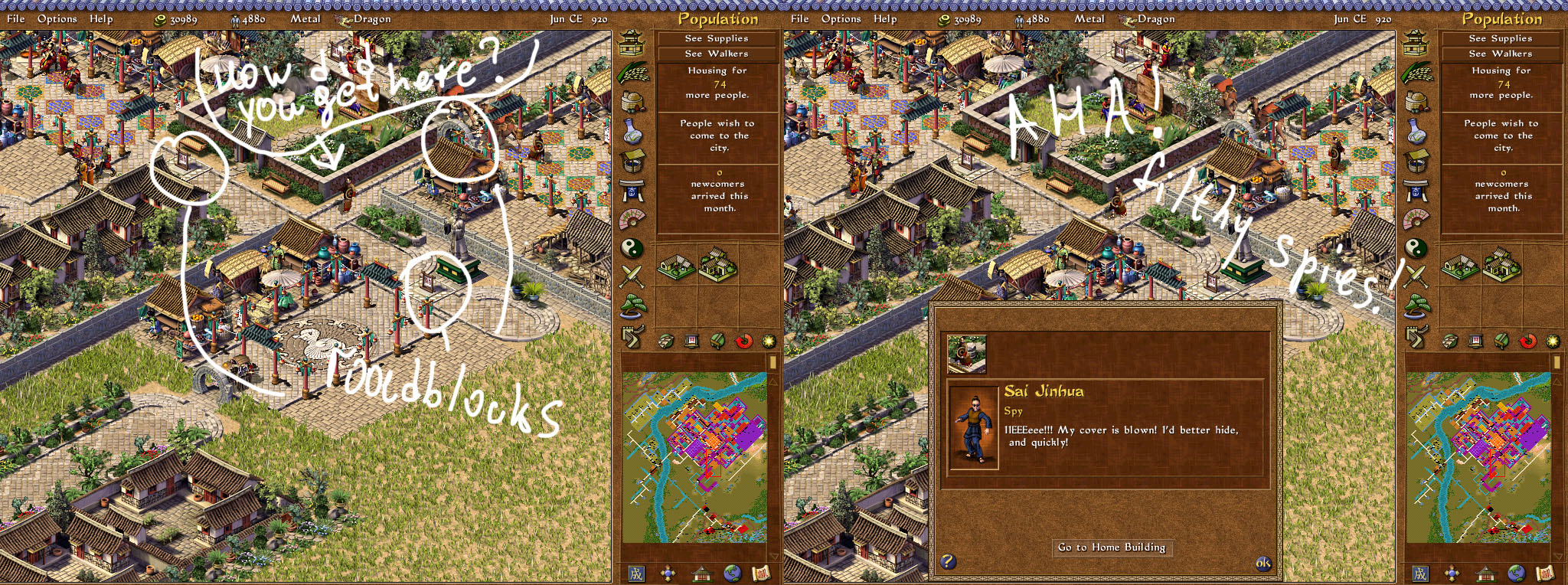
Another attempt at adding more interaction with the city are the spies. Spies are basically in the cities to attempt a sabotage. But the interesting thing about them is that you can prevent sabotage by actively inspecting the walkers in your city. I admit that there is something amusing and entertaining in spotting a walker that is walking where he/she clearly doesn’t belong. And while spies are extremely clumsy and easy to counter, they add more to the feeling of the city being alive.

china2

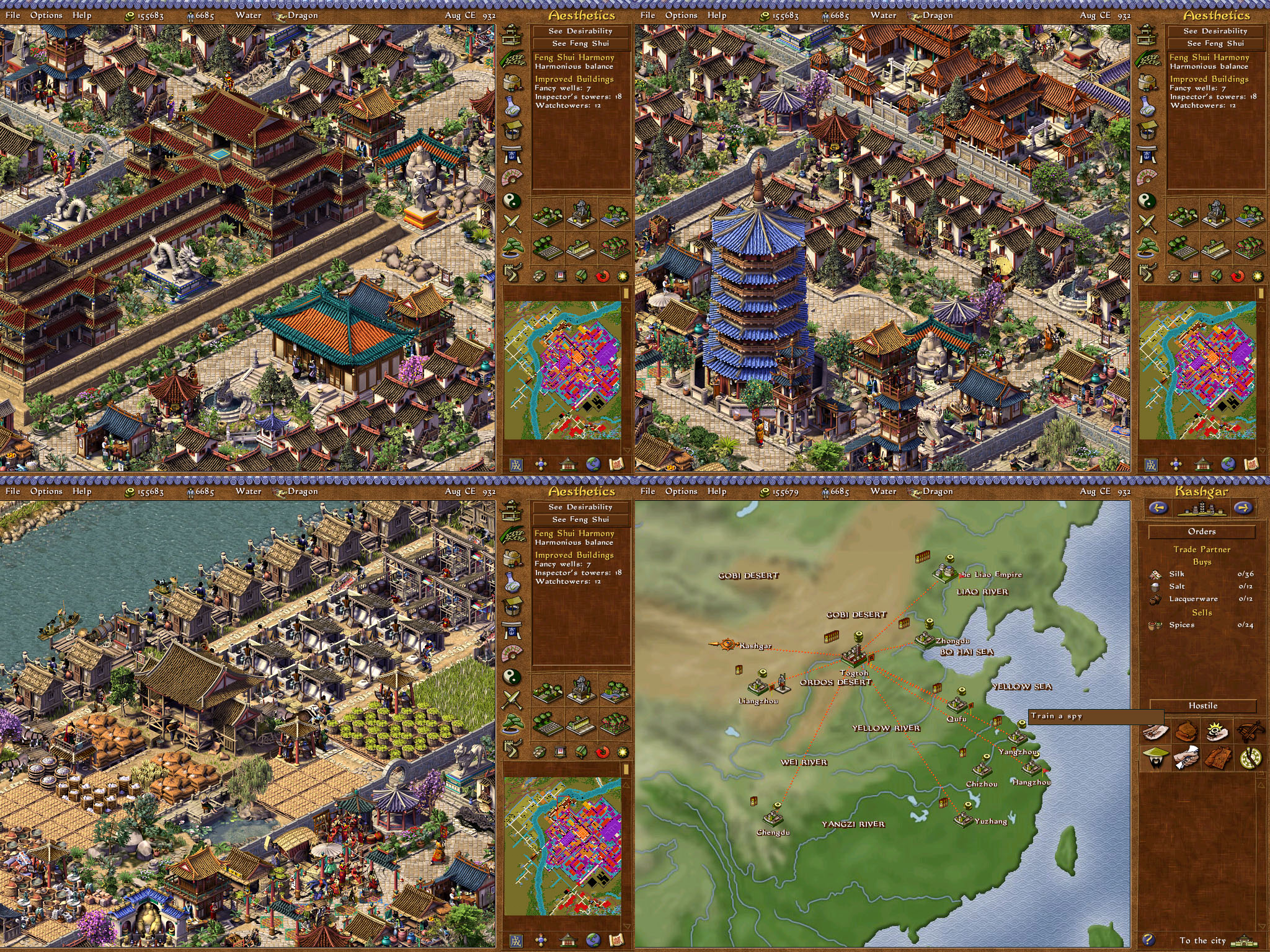
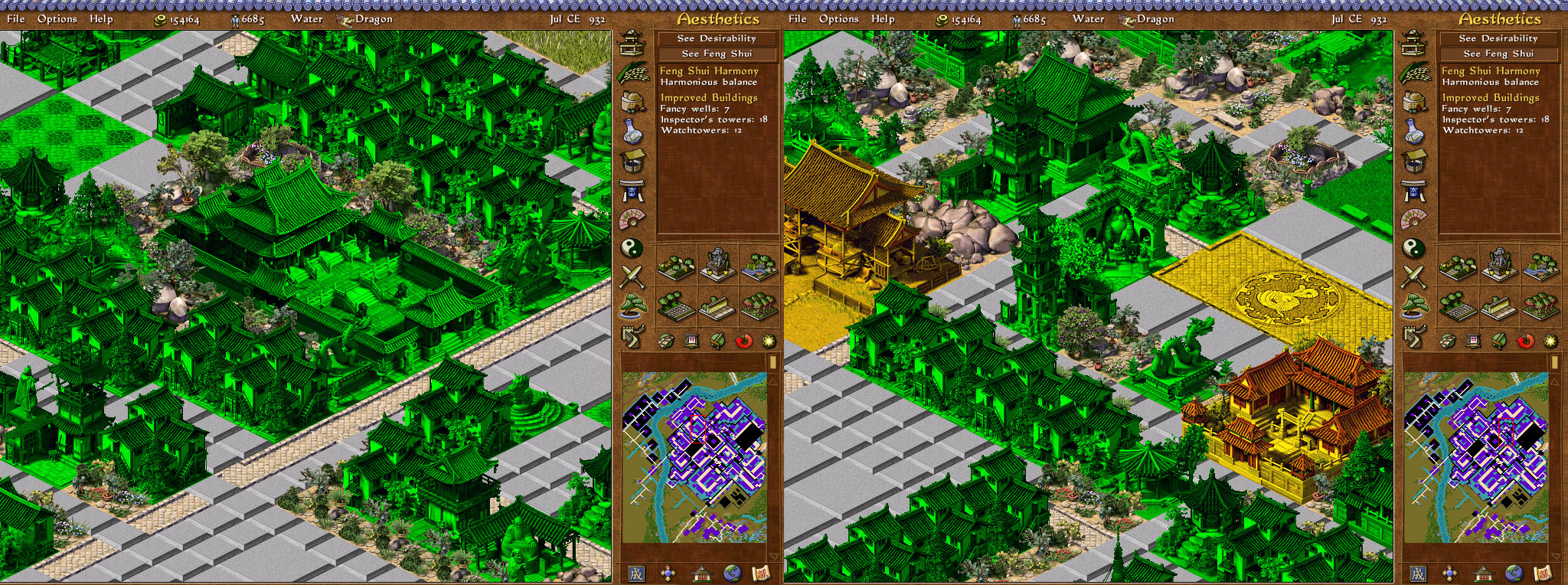
But the real diamond in all of these Asian curly rooftops is the feng shui system. No more copy-pasting the same district template everywhere! Where before the player just had to keep in mind that a district needs X squares for the services and then place the buildings anywhere, the player is now made to consider the placement of the intended buildings. The landscape (trees, stones and hill slopes, water etc.) now influences the placement of the buildings. Every building belongs to one of the 5 feng shui elements. To skip the details – placing too many building inconsiderably makes your city riot. This way I find myself much more invested into the architecture of the layout of the city than I was in the previous games.

china3

All in all, I find Emperor to be a nice conclusion to this series of games. Hope you enjoyed screenshots! And check out the bird’s view of my cities here.

Pharaoh/Cleopatra

Zeus

City builders: Pharaoh/Cleopatra

Note: To see the screenshots properly you have to enlarge the whole page. Free WordPress doesn’t allow enlarging images separately, unfortunateegypt1

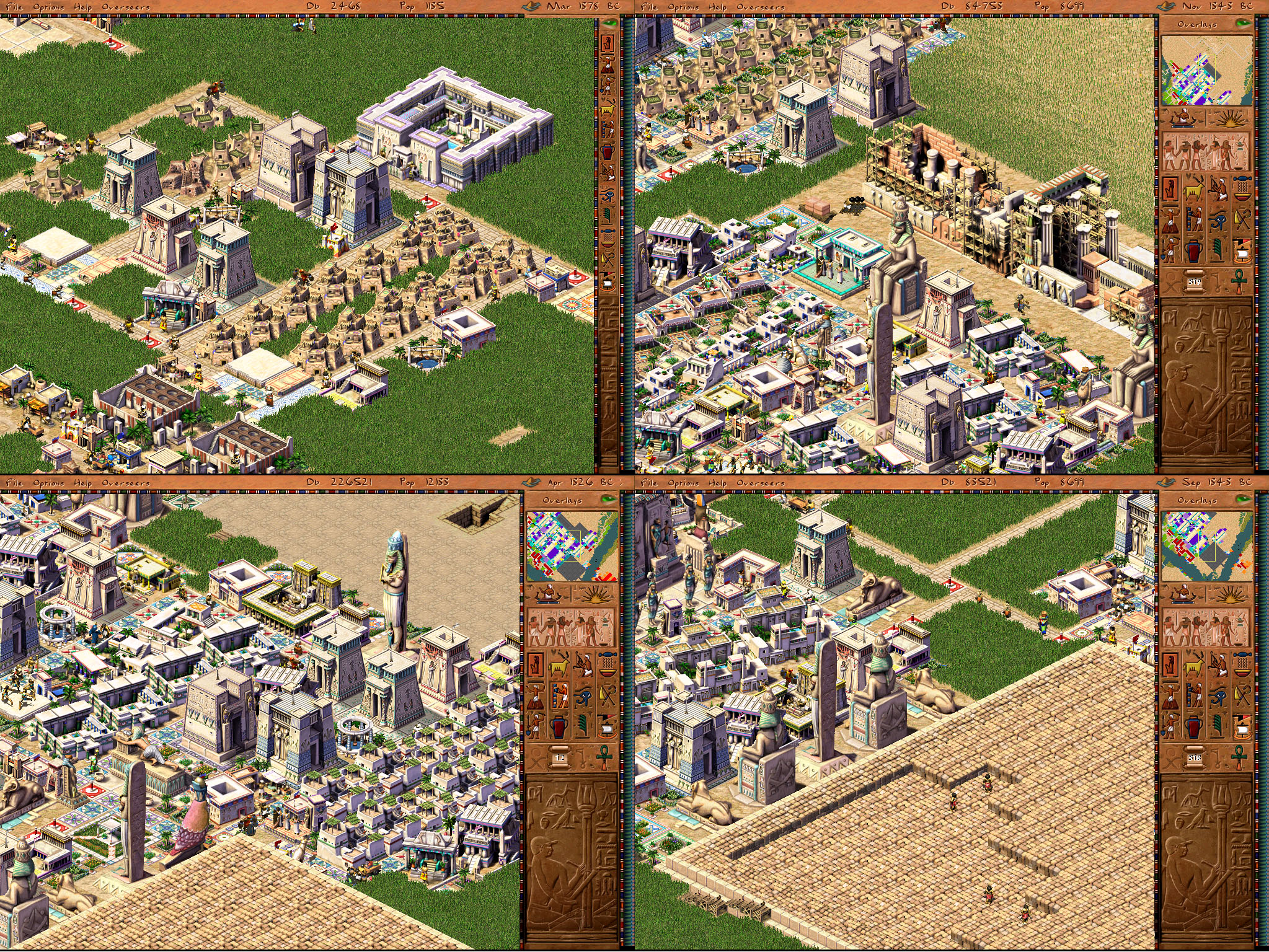
Next stop on our journey through time is Pharaoh from 1999. In this game, you become the administrator of various cities in ancient Egypt. This is the 4th game in the series made by Impression Games and published by Sierra Entertainment. This game also has an expansion called Cleopatra: Queen of the Nile that brought in some interesting monument projects to the game.

Here is the main activity of the game:

Build houses to get the population -> employ the population to create the food, goods, and services -> the houses get bigger (thus increasing the population) and give more tax income as they get the access to the food, goods, and services

All of the games in the series are based on this loop. Hell, most of any builder games are based on this loop.

egypt2

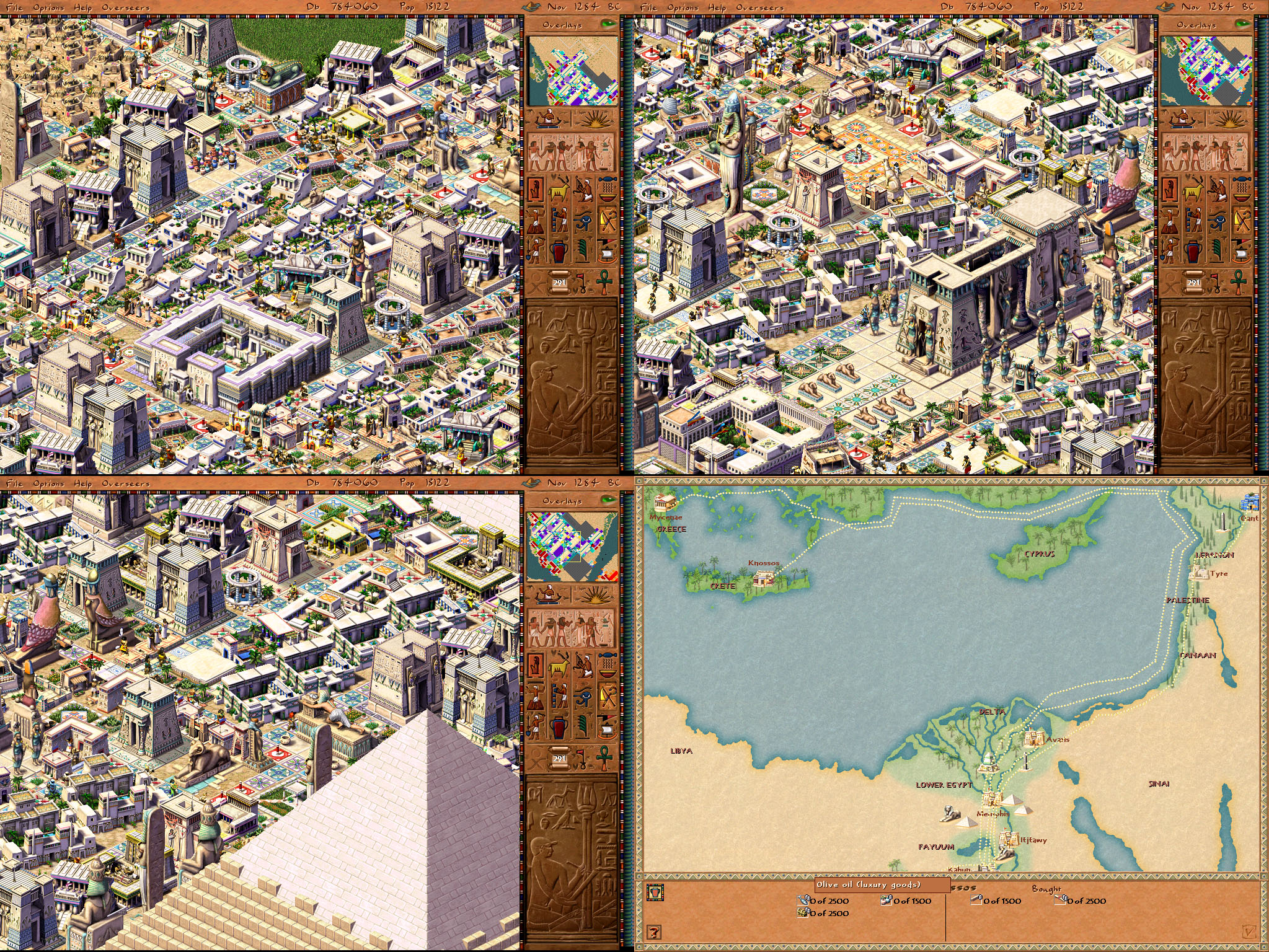
So what makes Pharaoh unique? The signature of this game, the way I see it, is the monument projects. These beasts take a tremendous time to create. The pyramids in my screenshots were built for so long that I finished shaping my city to the form I wanted and I STILL had to speed up the game and wait for around 30 more years for construction to be done. Actually, I started the medium pyramid in the middle of the playthrough and it got finished faster than the big pyramid… So, where is the fun? Surely not in watching this snail race? I find that the pleasure is hidden in building your city around these giants. That way, once the great projects are finished, you have a prosperous city at their feet for that perfect screenshot. Trust me, the satisfaction payoff is huge.

egypt3

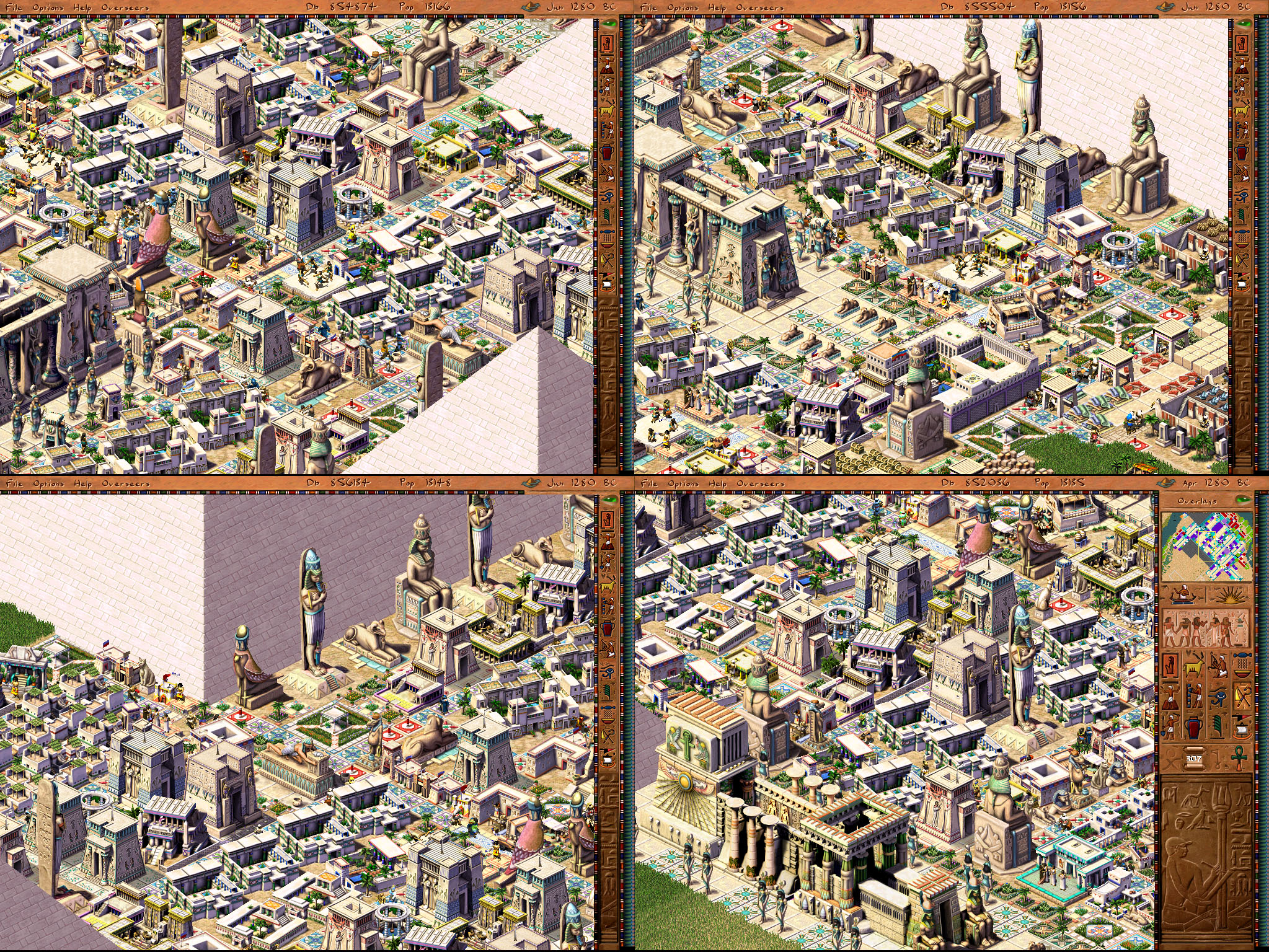
Another thing that I enjoyed while playing Pharaoh, were the festivals dedicated to the gods. The Caesar didn’t have a visual feedback for these activities, as far as know, while later games after Pharaoh changed their approach to religion. There is a sense of accomplishment in watching the festival square flooded with entertainers, priests, and scribes when you know that your first festival only had a couple of priests and a juggler. It’s a great way to show the player the progress and the growth of their city, as every new temple, stage, school, and a noble house sends a person to the festival.

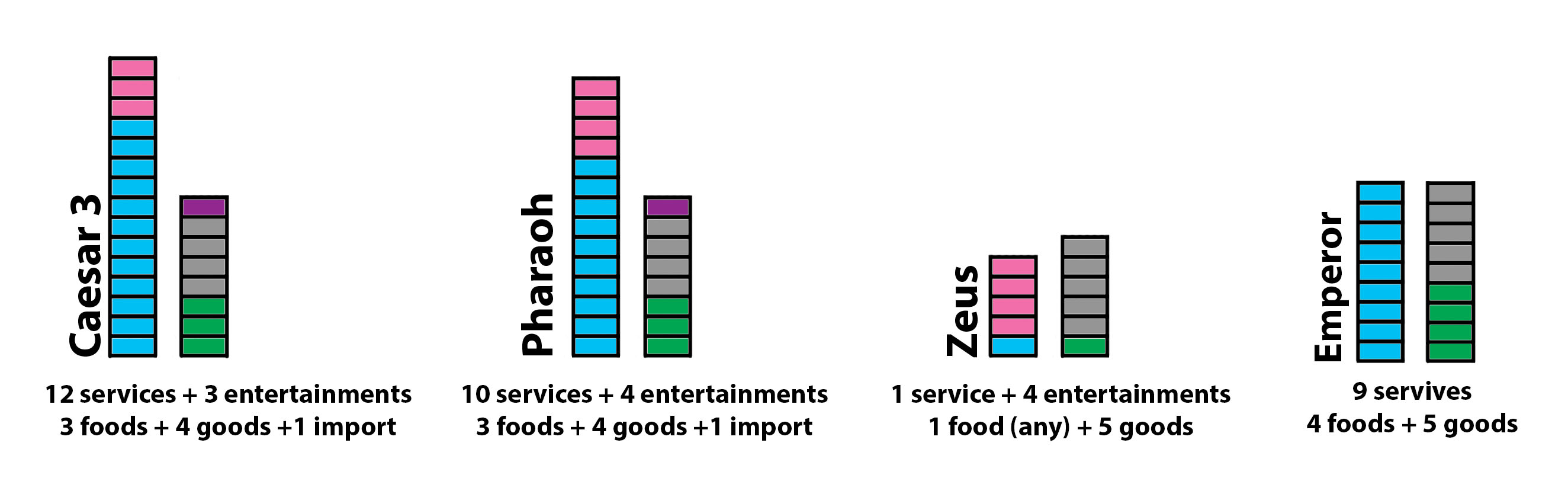
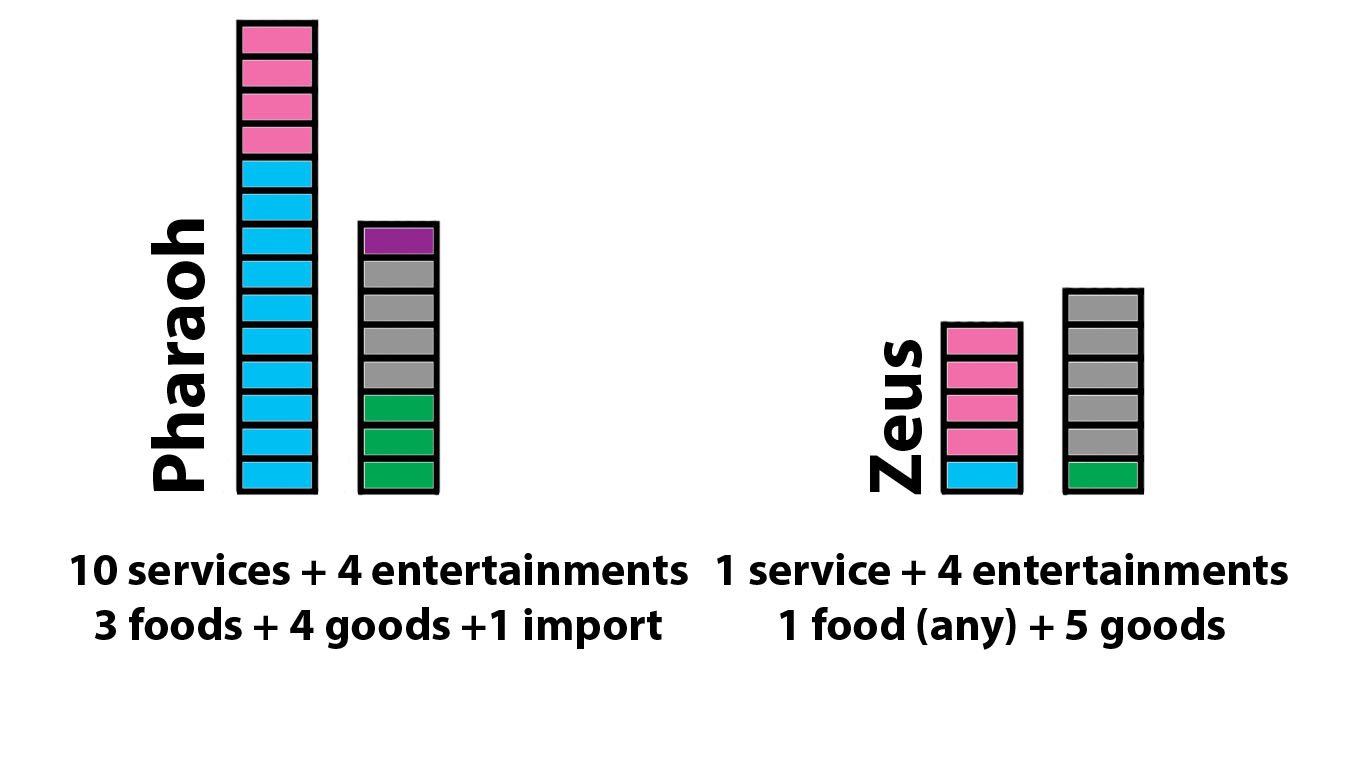
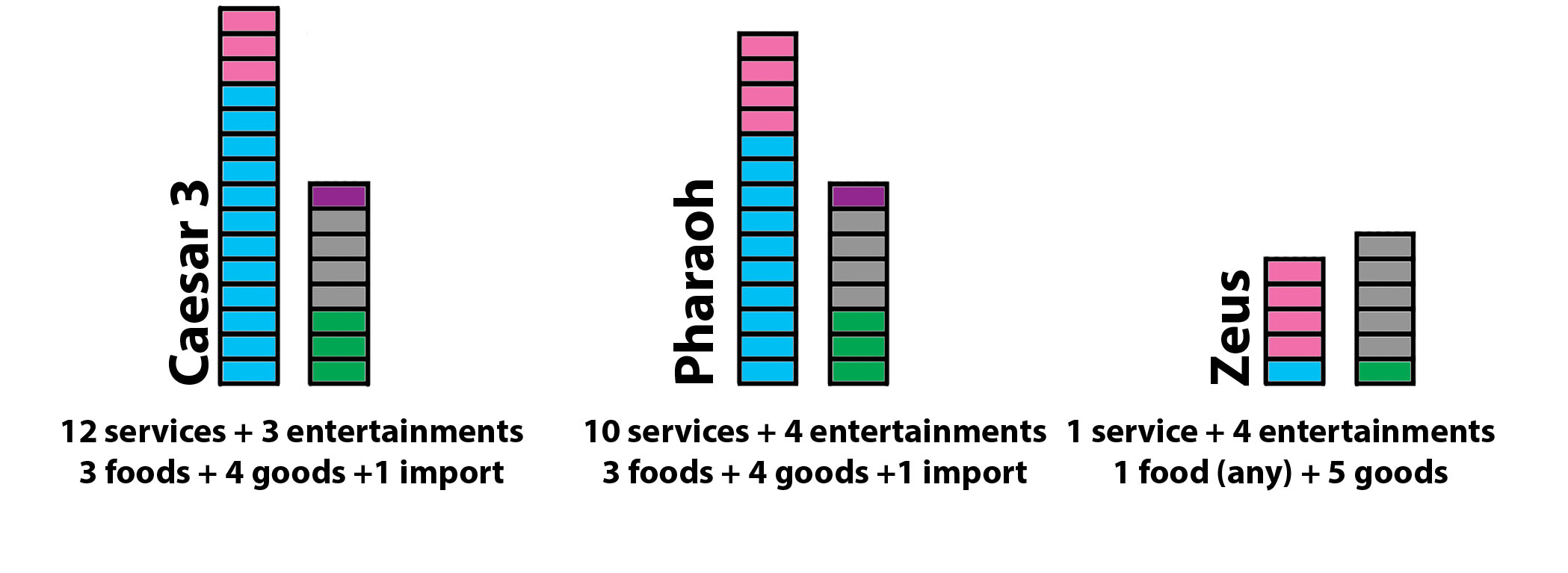
While I love Zeus for its aesthetics, the main reason I love Pharaoh is the mechanics. The mechanics that got kinda butchered in Zeus. The center of all these management games is to keep increasing the population while fulfilling their needs. And the complexity of this task is far more superior in the Egyptian edition then it is in the Greek edition. Here is a graph I made to show the amount of mechanics in two games:

stats_ Pharaos + zeus

I guess no elaborate explanation needed. The number of features that were involved in the housing mechanics was dramatically cut. I wonder what happened there? While looking into this, I got curious to see as to how many requirements the houses in Ceasar have had. Imagine my shock when I saw this:

stats_ Caesar + Pharaos + zeus

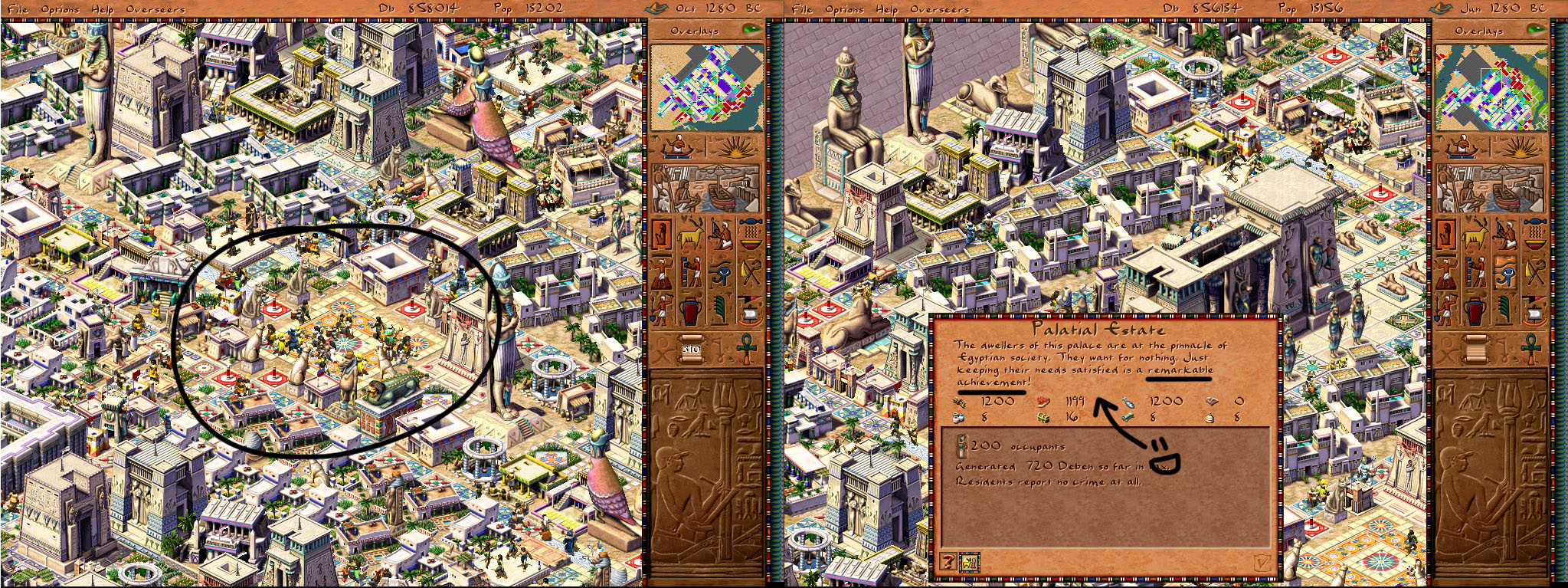
Turns out that Caesar was even more complicated than Pharaoh, even if it was just by one service. And in Caesar, you can’t control the flow of your walkers because there are no roadblocks! It must have been a pain to achieve the highest house level.  Pharaoh considers a similar feat to be an achievement. Anyway, I’m not going back to Caesar, that’s for sure…

egypt4

Hope you enjoy screenshots!

Emperor

Zeus

How my rulebook for a board game would look like.

The latest assignment that we have been working on in our course was to create a board game. This task, naturally, included the production of some sort of manual for the players to be able to play without an instructor.

Now, when it comes to writing the rules, I remember this part as being the weakest point of our blitz-workshops during the first year. And after I checked some manuals written by other groups for our current project, I felt happy about the way I decided to approach our own rules.

Note: this is written without any kind of literature as a reference point. It’s just the way I see this process.

General structure:

  • Introduction (to the “magic circle”)
  • Physical components
  • Board set up
  • Gameplay or player’s actions.
  • Turn order
  • Game end and scoring


Other things to think of:

“Stylisation” – the consistency, the flavour and the imagery.


Introduction

The way I see an introduction is a line where a player enters the “magic circle”. Now, don’t panic, I never actually read Huizinga so I don’t know in details how his magic circle works. But I still have my own interpretation as to how it might work. And in my head, the magic circle starts with reading the first paragraph of the rulebook. For this reason, it must introduce a bunch of questions, in an optimal way, to the player:

Who am I? Where am I? What is happening right now? What is going to happen?

You might not have answers to all these questions, but you should able be answer some of them. Obviously, it is easier to explain these questions if your game has a clear narrative and is based on familiar realities, but if your game isn’t like that, I would still consider making some story. Any story, to be honest. The way I did the introduction for our game project was to first have a paragraph that is an invitation (to answer the question of Who?, Where? and What?). Then I included a short paragraph of what is essentially the thoughts of a character in the game. But it is also the character that the player will become. In a way, these thoughts become the player thoughts to explain the “What am I going to do?”. I know, it’s not fair to place thoughts in people’s heads, but this was my solution for our project.

Finally, I included a paragraph that explains all the given information in a less flavoured and a more straightforward way to avoid any misunderstandings.

You can imagine it like this: you are in the theatre and you start to watch a play. After some time, you sneak a pick into your program (you know, the thing where they put all the names of the actors, their roles and, just to make sure the unclean masses are aware of what is happening, the synopsis of each act) to make sure you interpret the play in the correct way.

And that is the way I see the introduction, as a nice establishment of the setting, that pulls the player inside of this magic circle.


Physical components

Next, as a player, I would like to know what is inside the box. For this reason, I explain what are all the pieces and tokens in the game and how they might interact with each other. If one of the pieces has to do with the victory condition, you should mention that without going into much detail.

Why this part? Because we just introduced the player to a new reality where most of the things are happening in our minds. However, these game components are something that a player can touch. These exist, just like the player, in both realities simultaneously. For this reason, it’s a good idea to go “you know all this stuff in the box? All those card/paper/plastic pieces? They are actually not what you think they are!”. And now both the player and the pieces of the game are inside the magic circle.


Setting up the board

Now that the player is introduced to the physical components of the game, it’s time to construct the arena. Build this from bottom up: the bigger pieces are placed first, small pieces are placed last. You should mention if anything on the board has to do with the winning, but without going into much detail.

Btw, I personally consider generating a world as part of the gameplay, rather than board set up. Here is the reason why: because players don’t know yet what they can do in this world, thus making any decisions they take in generating the world mostly random decision. And for that reason, the world can just be generated by a random number generator. If you want players to generate a world with the awareness of the process, that is already part of the gameplay.


Gameplay (In other words – player’s actions)

After the arena is ready, it’s time to tell the players what they can do and can’t do. This section is supposed to explain all the possible interactions between the player and the elements of the game. Anything a player has the freedom to choose to perform should be mentioned here.


Turn of order

Now that we explained what is in the game, and what a player can DO, all that’s left is to tell the player in which order the things should be performed time after time after time (the loop) and when the game ends. This section is an excellent material to hand out to the players on a separate sheet of paper.


End of the game and the score

It is important to establish somewhere in the previous sections as to what exactly triggers the end of the game, but this here section is the place where I would explain in detail the conditions of ending the match and how the score is calculated.


And that is what I would call the technical set of rules and how to serve them to the player.

Once I have the technical parts of the game, I would then work through the whole text again and apply something I would call “stylisation”. This part of writing has to do with the consistency of the text, the narration or the flavour, and improving the understanding of the text via images.


Consistency

You must ensure that everything in the text is called the same way. What previously was synonymous now must to be called one way only to help avoid any confusion. Ideally, you should establish the names of your game elements long before writing the rules to help communication between the team members. But when you are writing the rules it is easier to identify flaws in the naming conventions. This also means that you can identify things that are called in a similar way.


Flavour

This part is connected to consistency in a way that allows you to call objects and actions in a way that fortifies your magic circle. The rules are part of the game and must reflect it through embracing the world they explain. Words like “cards”, “tokens”, “players”, etc. can be turned into “items”, “coins”, “lords and ladies” to emphasize the world that they exist in. In the same way, you should relay the rules of the game not as dictated dogmas, but as logical chains of events in this particular magic circle. Your rules may have a reason behind them mechanic-wise, but for a player that is irrelevant. A flavour text that explains why something can or can’t be done is a great way to help the player memorize the rules and create more emergence.


Images

This one is simple. To maximize the readability of the text I would like to have a picture of any physical part of a mechanic of the game that the text is explaining. This is a lot of work, and it requires some structuring to make a nice flow of text, but as the saying goes “a picture is worth a thousand words”.


And that is how my perfect rulebook would look like if I ever went into the making of board games, which I’m not sure if I want. But this assignment taught me a lot about how to properly present the information to a user.
City builders: Zeus/Poseidon

Note: To see the screenshots properly you have to enlarge the whole page. Free WordPress doesn’t allow enlarging images separately, unfortunately.

During this summer I only had the access to my laptop for most of the time. Unfortunately, it’s too much of a toaster to play any serious games for too long, so instead, I played some of my guilty pleasure games from the days bygone. Since the guilty pleasure I picked for my summer activity were old city building games, I decided to take some nice screenshots and write a couple of blog posts about these games.

So, to start this off, I played Zeus: Master of Olympus with the expansion Poseidon: Master of Atlantis. This game is a part of the city building series with the aesthetic focus being on different ancient cultures. The games were made by Impression Games and published by Sierra Entertainment. Here is the full list of the series:

Caesar (1992), Caesar II (1995), Caesar III (1998), Pharaoh (1999), Zeus: Master of Olympus (2000), Emperor: Rise of the Middle Kingdom (2002)

Out of these six games, I played four starting from the third Caesar. And this summer I played the three non-Caesar games. Also, as you can see I jumped straight to Zeus in this blog post because it’s the game I spend the most time in. But I will also write about Pharaoh and Emperor. And why haven’t I played Caesar? The short answer is because it sucks. The first two games I just disregard, as earlier iterations of the third Caesar, and even then, once you played later games in the series, going back to Caesar is hard. Or maybe I’m just being salty because I tried playing Caesar back when I was a kid and it was hard for me to grasp at that game. But it doesn’t matter because Caesar 3 has no roadblocks (something vital for the gameplay). No roadblocks = no fun, in my opinion.


Zeus/Poseidon

I guess I should start by explaining the general premise of any game of this series. You are building a city (shocker!). There is not much more to it. You create buildings to feed your population’s needs to achieve certain milestones, like population or production or conquest. The mechanics in the games mostly stay the same, but the aesthetics change dramatically. The series tries to reflect and educate about the social and cultural structures of the historical societies (not sure how accurately, but they certainly try).

AthensCut_jpg

I love Zeus for its aesthetics. When I was a kid, there was a book in our house that contained the Greek myths, the Odyssey and the Troy Epic. That book sustained a lot of traffic mainly from me. Zeus was also the first game to take the mechanics of the religion to a new level by making the deities into actual game world assets with personalities and a character. I do prefer this rather than having the gods as an obscure phenomenon that just requires you to keep it pleased through a menu screen while not actually being part of your city.

troyan war

And I hate how Zeus took a dramatic plummet down in the amount of mechanics that were present in Pharaoh and got simplified in Zeus. Emperor somewhat fixed the situation, but I sincerely wonder what made the developer to cut so many functional mechanics. There might have been a lot of them, okay, but the simplifying was way too overboard. I will demonstrate this in detail when I get to my Pharaoh blog post.

knowledge in the west2

The artist really captured Aphroditie’s boobs in this model, lol =D The model itself is a good reason to build this temple. No wonder the population’s happiness increases with this temple. Who wouldn’t like to have such a statue in their neighborhood? I mean, OH MY GOD, look at those bazongas…

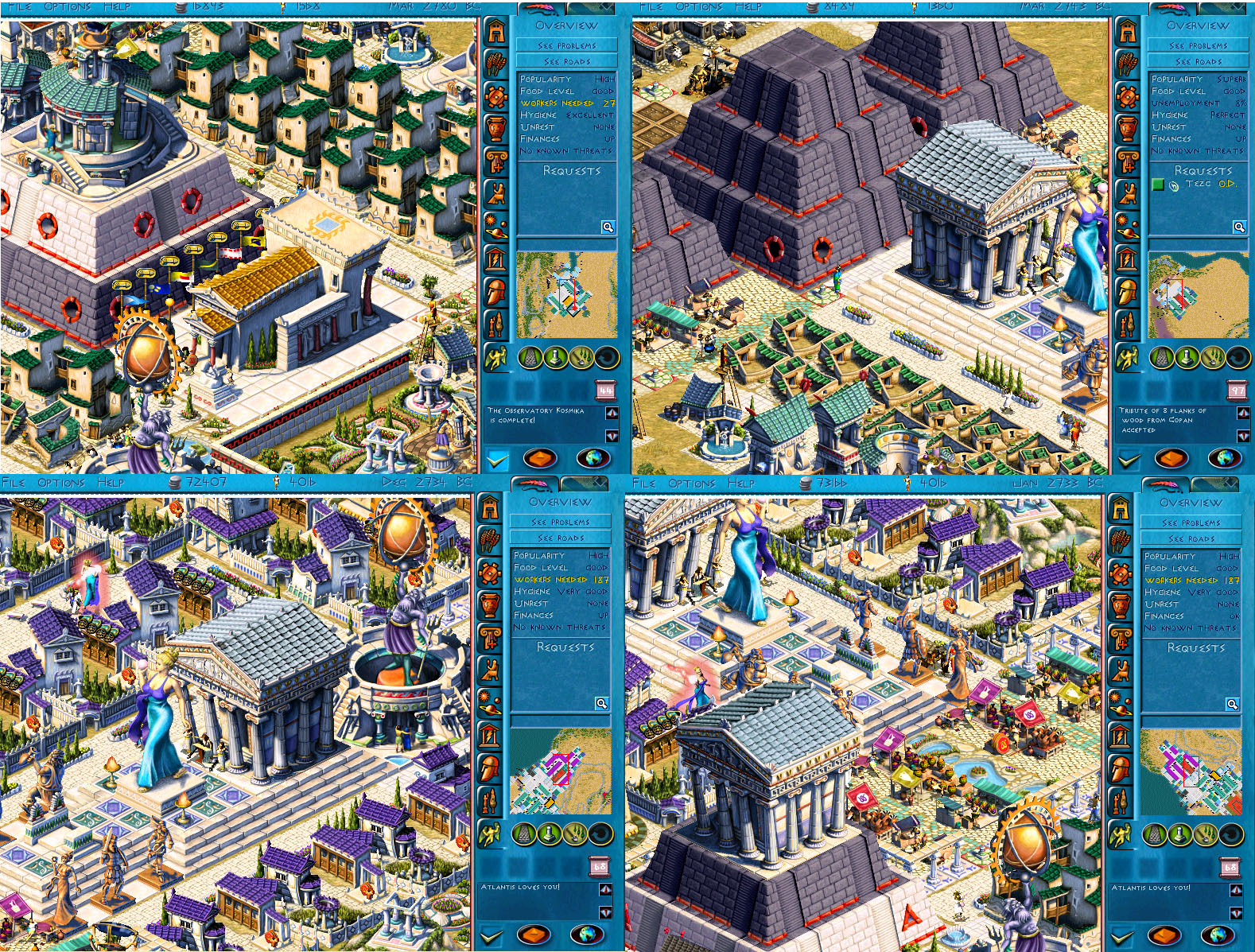
Another thing I appreciate about Zeus is the expansion Poseidon which tries to tackle the story of Atlantis. For that matter, one must also point out that Zeus campaign fuses together the history and the myths in an elegant way. And it is even more impressive with the Poseidon expansion, a story that is but fiction, yet what a well-done fiction it is in the campaign! We get a consistent story of the founding of the legendary city and the kingdom, the stories of their conquest and exploration into both west and east of Atlantic ocean, and the eventual destruction.

knowledge in the west

I got to build several beautiful cities, but unfortunately, going back to a 15 year old game wasn’t an all smooth ride, because there is a bug in both GoG and Steam version that makes animations of gods glitch, which results in them taking an unreasonable amount of time to spawn/despawn, to attack, to bless. This didn’t stop me from playing but this could be a deal breaker if you haven’t played the game before. In the end, it turned out that the last campaign, where the Greeks blast Atlantis’ into the ocean whence it came, was unplayable. The fisheries that were the main source of food for the city suffered the same animation glitch as the gods. I really wanted to play that one… =(


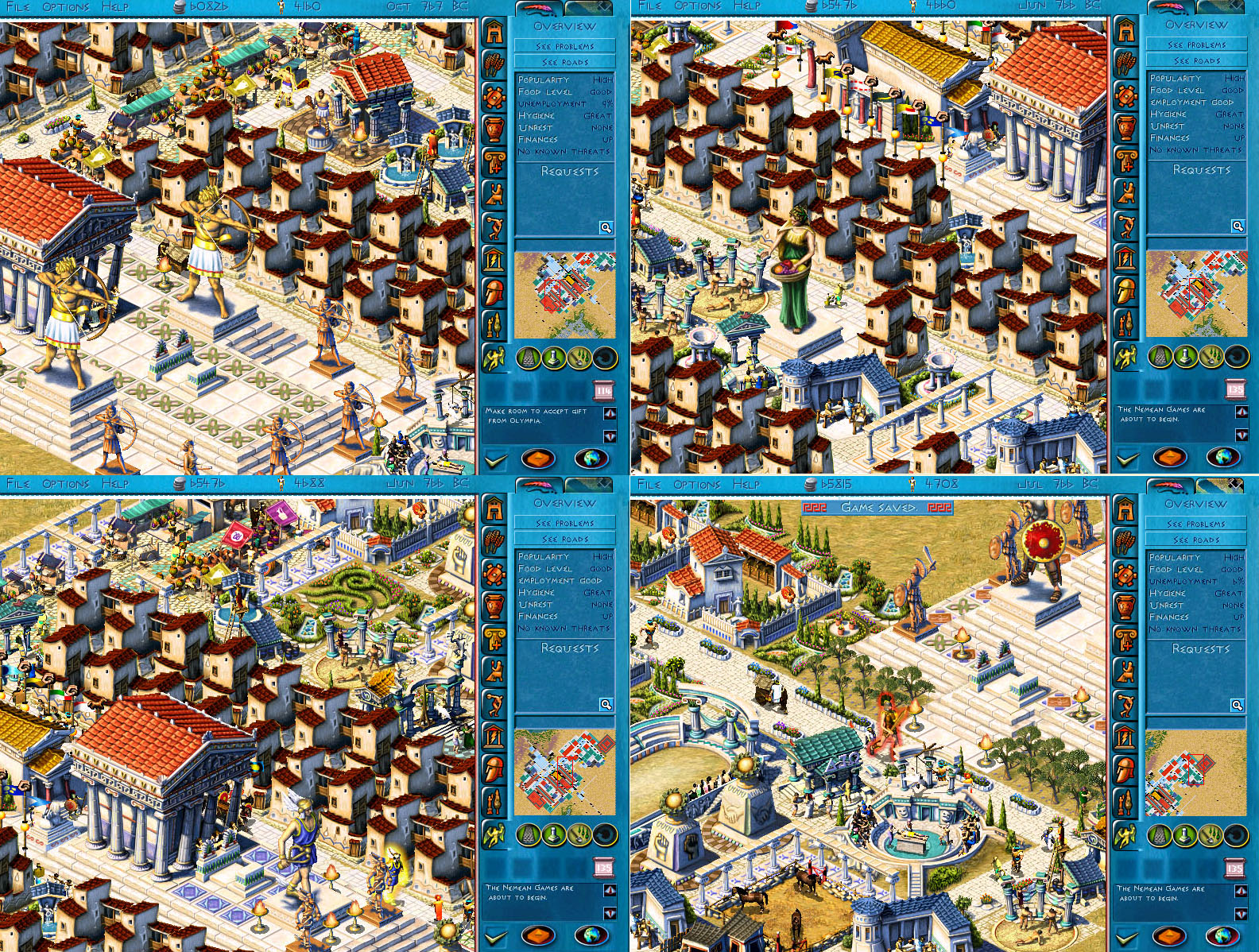
Hope you enjoy the screenshots! I think I have most of the gods captured in the pictures.

Pharaoh/Cleopatra

Emperor

What Knytt Stories taught me.

blog0

Finally, back to the blog after a scandalous amount of procrastinating…

blog1

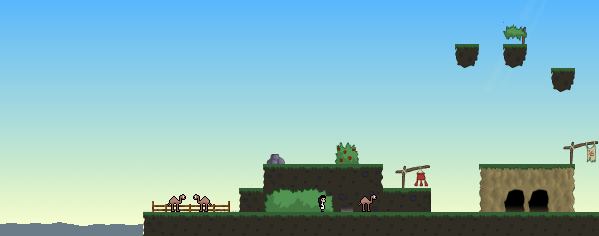
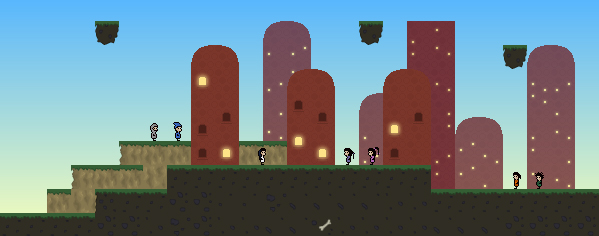
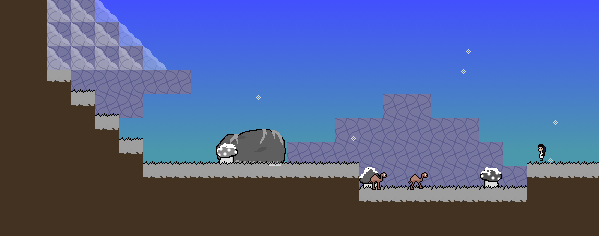
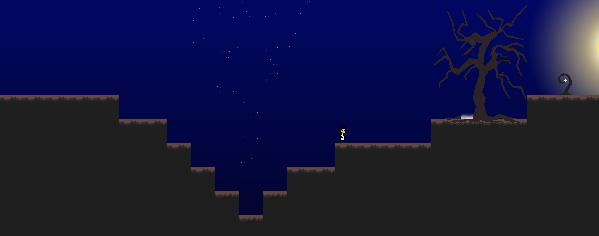
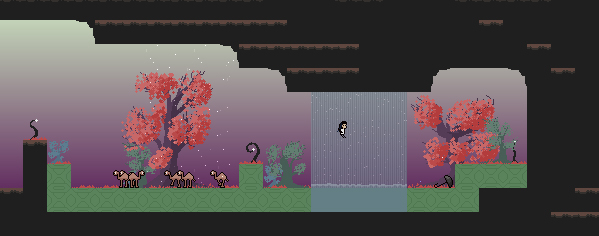
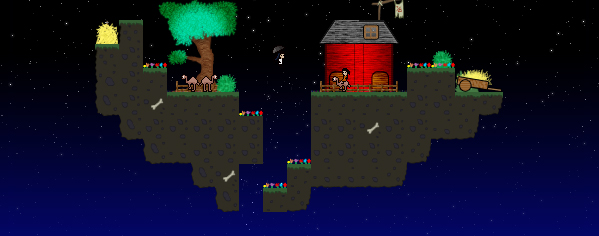
Our first assignment of the year was to build a level in a game called Knytt Stories. It’s a platformer game with a minimum amount of mechanics that is easy to grasp and play. This game also has a very simple though limited level editor that the students were required to use for the construction of the level. The assignment itself stated that we had to convey a dramatic narrative without using any words.

I feel that the delivery of my group was satisfactory. But during the time we worked on that assignment and during conversations with fellow students about this subject I realized some interesting things. I thought it might be fun to put these on (digital) paper. And some pictures of our level.

blog2

The distinction between the functions of the tool and the actual need for a specific function of the tool.

In other words, if you are handed a hammer and asked to hammer some nails,  you could go and start smashing people’s heads, but you should focus on hammering the nails.

In our case, I think this was the treacherous part of the assignment. If you were to give a bunch of game designers a tool that is good at building puzzles and challenges and asked them to build something completely different, they will probably end up building puzzles and challenges anyway. Sorry to toot my own horn, but I was very aware of this the whole time. That’s why I told my partner to just forget any puzzling and just focus on the visual part. But there was a general problem of people investing too much time in the construction of the puzzles rather than the stories.

blog6

Identifying drama is not a universal human skill.

So, back in the days of my language studies, we had a very mixed curriculum. Part of the lectures was taken up by the analysis of classical Russian literature works. I suffered through those, to be honest. I hated how novels and poems were dissected to reveal patterns, tropes, and methods of storytelling and writing. But in the end, I think, I should be thankful, because those lectures helped me to be more familiar with the ways the narrative worked. And I was clearly taking that for granted, as it turned out that the ability to identify and reconstruct dramatic narrative is not something everyone has or knows how to utilize.

This whole scenario just in a way confirms how everyone perceives things differently. Something that is apparent to a writer may not be apparent to a programmer and vice versa.

blog3

Narrative without the words is a bia-a-atch.

Imagine that you are good at constructing a narrative and then you are asked to create a story that has no words, but only images. A cheap way out of this situation is to turn to the tropes. Those things are so imprinted into our consciousness that there is a little chance for miscommunication. But you are also discouraged to use tropes because that is too boring. So, you are stuck with a shitty level editor with a limited amount of editing possibilities. And here is an interesting thing: even if you trope the hell out the assignment or try to be original – as long as you don’t make a level that is a puzzle, but a resemblance of some story, you are good. Because the limits of the editor in the visual convenience and the ban on using word narration obscures the semiotics of meaning enough to blame any misunderstandings on the difference in people’s perceptions.

blog4


P.s. Try to figure out the narrative of our story from the pictures =D

blog5

1-year milestone. Finish line.

Since this blog series is supposed to be a map of things that I want to take away with me and perhaps refer to at a later point in life, I should tell about the most interesting thing that happened to me. What pushes a first-year student to write an extensive Post Mortem of a whole year of studies­? No, it’s not an iron discipline or a desire to be productive 24/7. I could be doing other things or not do anything at all, yet something compels me to write down anything that comes to my mind and reach out people with my thoughts and be willing to hear their thoughts. This isn’t a common behavior for me, personally. A week before GGC I felt miserable, yet now I feel more alive than ever. So, what the hell happened?

A short (yet very complicated) answer to this would be this: I might have found God (or maybe god?).

Now that I, hopefully, have you intrigued let me explain with a longer answer.

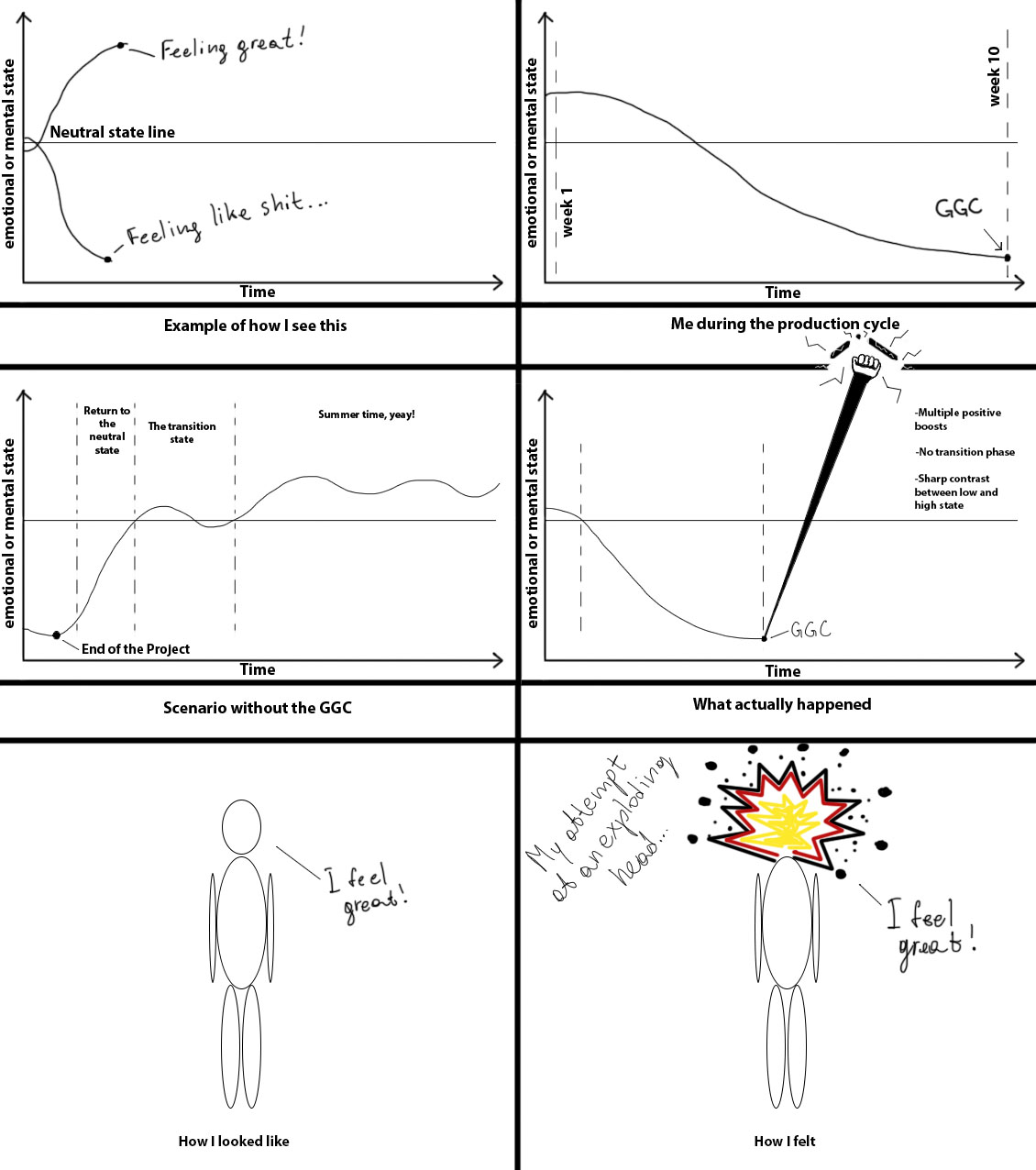
Ten weeks before the GGC I joined a group to make a game for the expo. I felt optimistic and was full of hopes. By the time the GGC started I was mentally crushed into what I can only call a state of mild depression. All I wanted to do was stay in bed or, even better, get drunk. This state is what I based my concept of group harmony off. Obviously, there were problems in the group project that went unresolved that were influencing the state of my mental health. And I assume that after the project was finished I would have gotten back to a normal state. Then what does God has to do with anything? It’s because of what I felt during GGC and how it influenced me. Let’s start by saying that I thought that GGC was great!

  • I got to listen to different speakers who came to check out student projects. I was especially moved by the example of how games can tap into deep human emotions like grief.
  • I got to see the craft of my fellow students and admire their achievements. I was happy for them being recognized with prizes during the award ceremony.
  • I witnessed that my game that brought me so much unease was recognized as a part of the GGC2017 showreel.
  • And during the GGC I figured out what the problems of our group were. This is important because rather than just moving on, I had objective reasons for our struggles.
  • And when GGC ended I had a chance to talk to many talented people with whom I have barely exchanged any word over the course of the year. I experienced a sense of unity with these talented people and wanted to be a part this collective that reassured me that my work had value.

All of this together combined resulted in a feeling of exaltation that lasted at least for a week. But I also think that all this can be illustrated for a better understanding.

This is based on my theory about team harmony/disharmony but on a scale of a single person. And I am not a phycologist, so don’t take this too seriously.

GGC feels in pictures

If my unhappiness was based on the group work than it is possible to assume that once the group work end I would have eventually gotten back to my normal mental state, maybe fast or maybe slow. But the point of the release itself was the GGC where I was able to safely say ‘I am done with this project’. But instead of just recovering my balance I got a boost of several positive influences. This resulted in a sharp difference between feeling awful one day and feeling extremely happy the next day. It is this contrast, without a slow transition, that exploded my head.

I would keep telling my roommate how happy I was for several days and when I described this to a Liberal Arts student he said, ‘It sounds like you found God’. I am not a religious person but I thought that it sounded very poetic. And how cool is it to tell people ‘Why am I in the game industry? Oh, no big deal. I just found God there.’

And that is how I ended my first year as a game designer and why I wrote all of these blog posts. It was the contrast of having no ideas for weeks and then having my mind flooded with ideas and thoughts 😀

Thanks for reading!


1-year milestone. Part 3.5: My beef with artists/coders/producers

This is the second to last thing I want to write about. All the complaints I can think of about the other team members and their line of work.

My “head count” so far:

A luxurious number of artists: 5 different artists with their skills ranging from high to low.

2 Programmers who both were brilliant.

2 producers who together can be considered as much as 0,8 producers. It’s was a complicated situation. One of the producers hated this line of work, we were informed of that and didn’t consider him a producer but rather an extra member of the team. The other producer dropped half way through the project.

A good design is a design you don’t notice. Same thing goes to this blog post. I only write about stuff that disrupts the process of work. And from my “stats” it is not a surprise that I have most to say about the artists. But I will be fair and try to mention as much as I can about programmers and producers.

Also, since I am a designer, I can’t really write much about designers. I have already discussed extensively how I see this line of work. But if you have some tips and pointers about your beef with a designer – please share.


Artists:

Sketching, work in progress, sharing. I think I have mentioned these separately in other places and now I will mention these in the direct context of team members who don’t do this properly. If you, artsy people, don’t do these 3 things thoroughly it will result in one thing only – the designer saying, “This is a great picture, but it’s not what we need”. The designer feels like crap for dismissing your work, you feel like crap for having your work dismissed. Everyone feels like crap. It doesn’t have to be this way.

  • Learn to sketch: When you are told to draw something, you need to not present a single picture (unless there is ABSOLUTELY no room for a misinterpretation) but a series of simple drawings. The point is to experiment with the idea and the picture. If you are asked to draw a frog – make three or five or ten sketches of different frogs.
  • Learn to show your work in progress: Once a sketch is chosen, you can start coloring and filling in the details. If you worked on something for several hours, I assume there will be more than just a sketch by that point. And as a designer, I want to see which direction your progress is going so I can intercept you in case you strayed too far from the course. To prevent this, I NEED to see what you are doing. This isn’t just for me to complain. I might have miscommunicated something or didn’t give detailed enough description, or left some area of the idea blank and need to go back to specify it. Seeing your work in progress is as much important for the designer as it is for the artist. This isn’t a freaking competition, we work together. And this will prevent the need to send you back to your tablet when you bring me something finished that is not what I asked you to draw.
  • Learn to share: I personally would love to see everything in our shared folder! Any sketches, any progress on the picture at the end of the day. But what I, sure as hell, want to see in there are the finished pieces. Jesus Christ, how hard is it to upload you finished work? Must I ask 3 times to do this? If you are suddenly hit by a car while caring your laptop with all your work and the laptop is destroyed – all your work is gone. We can find another artist, but it would have been great to not get thrown back to square one because someone was sloppy at uploading. Sorry for sounding cynical, but that is the truth of it. You need to make sure your work is shared and saved somewhere where other can have access to it in case something happens to you. Preferably .PSD thx!

Some people are shy and unsure about their work (see Imposter syndrome) but you need to find a way around this. These three things aren’t just a matter of the workflow. They also show that you as an artist is working and contributing. If you hide your work from me, I will assume that you are slacking. This doesn’t apply to just artists, but also coders/designers/producers.


Polish that never happened. I have heard a lot of times us say “it’s good, we will also polish it in the end” and then that polish never took place. You are, obviously, not required to give us assets that are 100% finished. But you must be aware of the things that need to be done later when all the visual assets are brought together. This is something a producer should keep track of, but also you yourself. If only 1-2 weeks are left, you must go back to your assets and inspect them and make finishing touches. Preferably something that is detectable by us, simple mortals, otherwise one can again assume that you are slacking.


Criticism towards the art or criticism towards the design? It is true that artists are the highest authority in the questions of Art. However, an artist needs to realize that someone else who isn’t an artist could give a legit critic about the artistic side of the artifact. In other words, someone who isn’t primarily an artist may have some knowledge about the technics and the theories that are within the domain of Art. Another thing to consider is when the critic is directed not towards the art side of the picture, but towards the design. And if this critic comes from, let’s say a designer, then you, an artist, are no longer in the position of power. No matter how good you have drawn that horse of yours, if a designer asked you for an elephant, you have clearly missed something.

While we are on the subject of deeming someone’s art, you know what else? I don’t give a flying fuck about how many people in what high places deemed that horse of yours as brilliant. Did those people examine your horse as an isolated piece? Or did they examine it as a part of a chain of assets? Did they read our concept document or talk to the designer about the vision of the game? If someone said that this horse is a pinnacle of the artistic expression – put it into your portfolio and go draw my damn elephant. While artists can judge the craftsmanship of the picture, I can judge whether you follow my design or not. And since I know my design best because it is MY design, opinions of all the experts in the world are secondary. But I am always open for a discussion, of course.


Unconscious design. When an artist shows me a picture or a sketch of something that looks strange or intriguing but not as I imagined, I will ask them as to why this picture looks the way it does. And you know what a good artisan shouldn’t answer? “Because it looks cool”. To me, such an answer is the demonstration of the fact that the person wasn’t actually thinking about what they were doing. Perhaps there was some reason to it, but the artists didn’t bother to formulate it and understand it. I want to hear your reasoning, your thought. Perhaps there is something in this that escaped my understanding. Share your feeling, sell me your vision. But if you don’t even know why you are doing things, there is a little chance that I will know why you are doing those things. Any explanation that connects the picture to our concept or to the other existing elements is better than hearing “Because it looks cool”. And this might work if you give the designer a dozen of pictures/sketches. Then the designer can look through them and choose something that is closest to his vision, cool or not. But if you only deliver one image and even that you can’t motivate, you have clearly been slacking.


Programmers:

Unconscious design, only worse! While an artist must interpret and understand what a designer wants, a programmer deal inside a very strict frame. It is much easier to draw a diagram for a programmer to work with, rather than to draw a sketch for an artist. Remember that you are finding a code solution to a specific problem. To get from a programmer some mechanic that wasn’t intended because the programmer thought it is cool is ten times worse than an inability from of an artist to motivate their creating. Something that an artist thought was cool could be erased in a matter of seconds and doesn’t influence the product yet. Something that a programmer thought was cool sends a cascading wave when the new mechanic interacts with EVERYTHING in the concept, dynamics, aesthetics. The problem usually is that none of this was accounted for by the designer so the results could be disastrous. For this reason, if you come up with something that you think is cool, first tell about it the designer. Perhaps make a separate prototype file where you show this mechanic so that the designer could inspect it without worrying about the whole game client collapsing. And the same thing applies, as with the artists, motivate why you think it is a good idea. Don’t say you find it to be cool…


Ask for help. As a programmer student, no one expects you to know the most optimal solutions to your problems and the code you are asked to create. It’s ok to not know how something can be made to work. Ask your fellow students and teachers for their opinions and advice once you are stuck. DON’T go for a week trying to find a solution on your own. Spend a reasonable time on thinking on your own and perhaps searching the internets, then turn to others for help. I’m sure the teachers can help with most of the things you could possibly have trouble with. Also, if you can’t understand something that the designer asks you to code, ask the designer to show an example in another game or to make a paper prototype.


Producers:

I tried to think of something to write here, but there is nothing. I had no experience of a real administrator watching over my shoulder the whole project so I can’t really say anything. Except that I know for a fact how much easier it is when there is someone dealing with all the routine like schedule, a place to work, keeping track of progress, deadlines, individual effort etc. I know that the first year the Project Management program run was not a smooth ride, but this goes to all of us being the first people who got the taste of the 4 courses. I hope that the feedback GAME got was sufficient enough to make adjustments.

If you have something you can say about the producers, please do. But don’t rant about producers who were clearly not doing what they were supposed to do in their role as a producer. I would rather like to hear about a producer who gets the job done, but could do it better and interfere with the workflow less. Warning flags of a disruptive behavior and such.